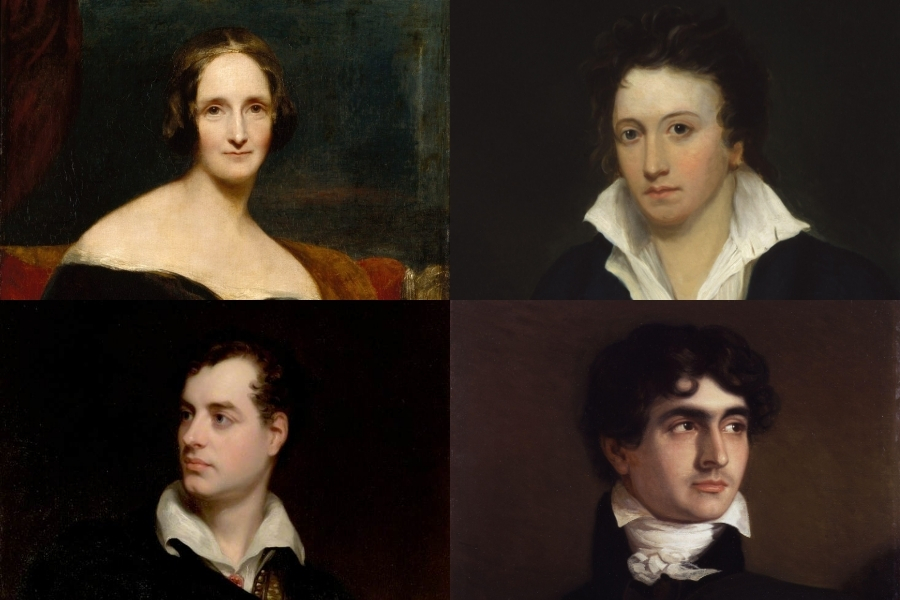


The faces of Frankenstein
From Universal Studios’ lumbering green monster to Tim Curry’s fishnet-wrapped madman, “Frankenstein” has been remade to death — and not the kind a 20-something revives with a cry of “it’s alive!” But Guillermo del Toro, cinema’s patron saint of the beautiful and the grotesque, knows how to resurrect this corpse for the 21st century.
Following his Oscar-winning “Pinocchio,” his newest film in collaboration with Netflix finally delivers the Gothic classic Mary Shelley penned during that Genevan summer — not a tale of horror, but of grief and guilt. As a self-proclaimed “Frankentologist” myself, the film felt truer to Shelley than any adaptation in decades.
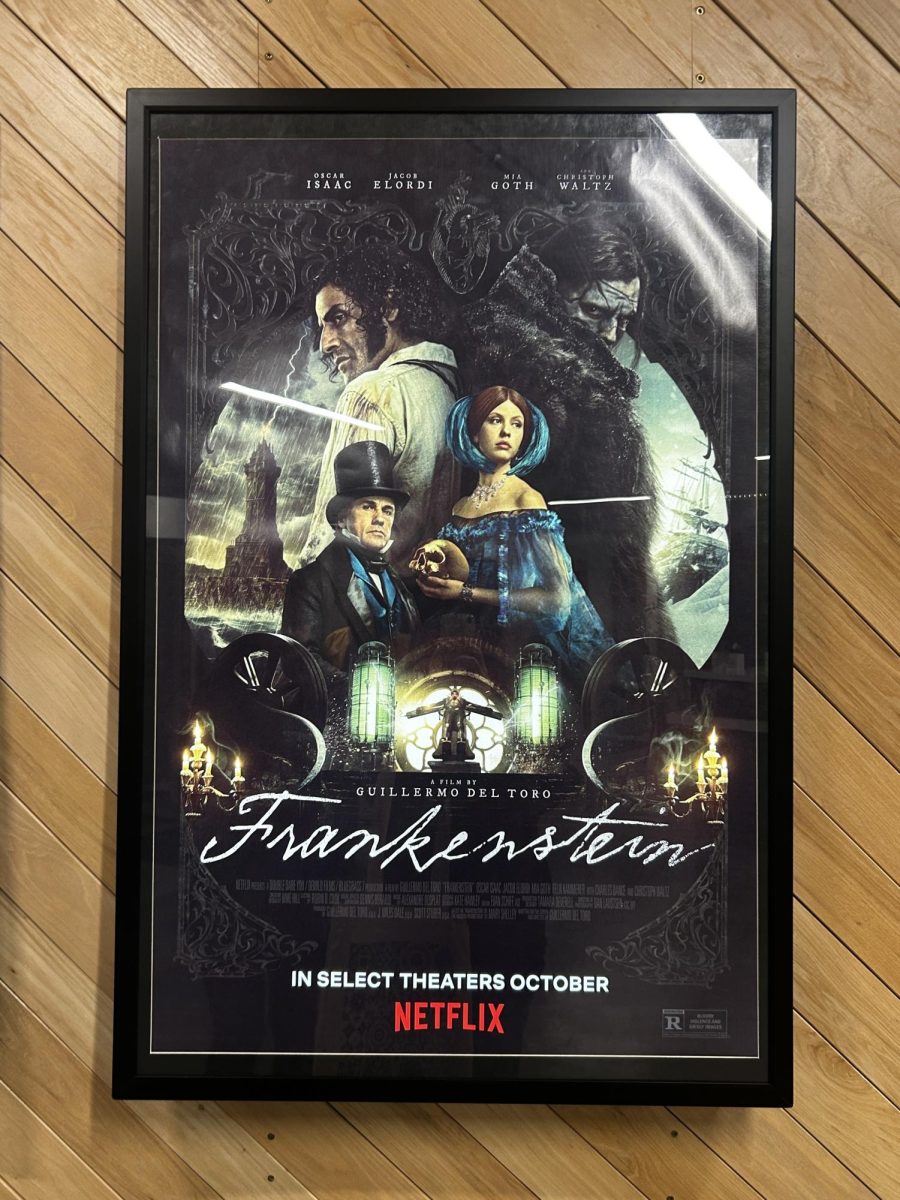
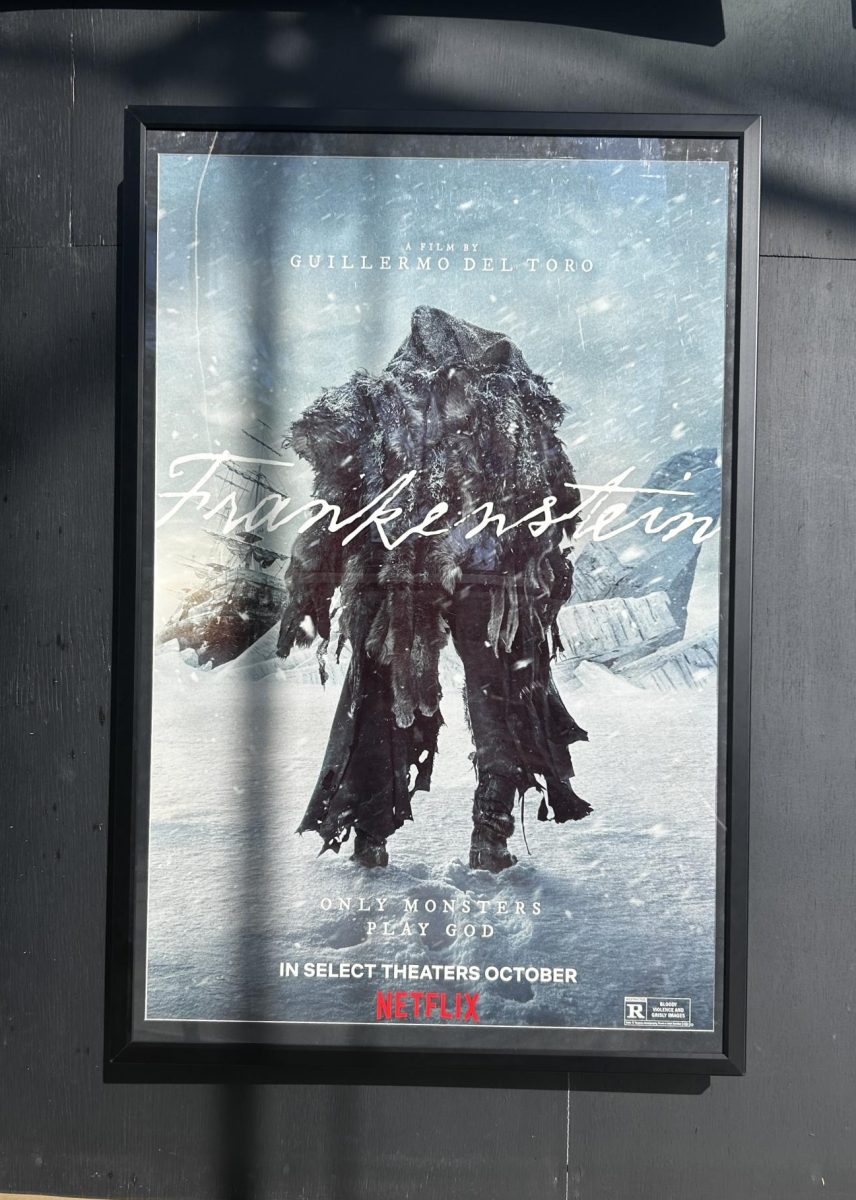
Del Toro’s “Frankenstein” premiered Oct. 17 at 10 IMAX theaters nationwide and in select venues in New York and Los Angeles. The film opened at FilmScene at the Chauncey, Iowa City’s nonprofit art-house cinema, Oct. 24. After a limited run ending Oct. 30, it began streaming on Netflix Nov. 7.
The forbidden
Del Toro’s film opens not in a thunder-lit laboratory, but on the Arctic ice. A crew of sailors discovers a collapsed man (Oscar Isaac as Victor Frankenstein) and, moments later, the towering creature (Jacob Elordi) who pursues him. Their meeting, two figures framed against a white horizon, captures the Romantic ideals of the sublime: terror and beauty so intertwined they are indistinguishable.
Despite what popular culture tells us, Isaac’s Victor is not a mad scientist so much as a scholar. Raised by a baron-surgeon father, Victor learns early to view the body as an instrument rather than a vessel. In one of the film’s sharpest inventions, his father asks him to compare the weights of two human hearts, one male, one female. His father then proclaims that the male heart’s extra weight comes from mass, not emotion. From that point forward, Victor’s choices are direct results of having been taught that excessive emotion in a man is weakness, something to be cut away for rationality.
When Victor at last animates his creation years later, the film delays the thunderclap. The moment didn’t feel victorious to viewers because the horror isn’t in what is made, but in how it is made. Specifically, by a man who has forgotten what it means to receive life, not just give it. When Victor falls in love with Elizabeth Harlander (Mia Goth), he even remarks that “life got in the way,” shrinking human intimacy into inconvenience. It’s a buried line, but to me, it defined the film to be about the arrogance of invention, and the sin of making something — or, more accurately, someone — only to turn away once it breathes.
The feminism
Shelley, the author of “Frankenstein,” was the daughter of the feminist philosopher Mary Wollstonecraft and the radical political writer William Godwin. Eleven days after her birth, Shelley’s mother died of puerperal fever. That maternal absence, and the pressure of her mother’s legacy, haunts “Frankenstein,” and Del Toro’s film gives that feeling life.
For most of the film, the palette is suffocatingly cold, washed in greens, blues and grays: colors of restraint. It’s a world preserved in ice, and red appears only in what Victor can’t control or own. His mother’s dress, blood-bright in an early flashback, stains the memory of his childhood. The gloves he wears to create the Creature carry that same shade, as though he’s dipped his hands in what he refuses to name — a woman’s work, creation.
Additionally, there’s Elizabeth, whose red umbrella cuts through the muted cinematography of England. Red becomes the color of the forbidden femininity: of blood, birth, desire and those hearts his father assured him were mass, not mercy.
Del Toro’s “Frankenstein” understands that Shelley’s novel was born of a woman mourning her mother, and a world that feared women who create. Against Victor’s glacial world, red endures. It insists that what men call monstrous — life and death — is often only what they can’t control.
The finale
I first read “Frankenstein” when I was 12. Since then, I’ve collected nearly twenty editions — clothbound, annotated, illustrated, translated — and I still flinch every time someone calls the Creature “Frankenstein.” The tragedy has always belonged to Victor, the maker who mistook ambition for innovation. Shelley knew that, and del Toro knows it too.
The film acknowledges the myth it inherits while reclaiming the novel it came from. Shelley’s Prometheus — the Titan who stole fire from the gods and with it sculpted Man — is everywhere in del Toro’s vision. From Heinrich Harlander (Christopher Waltz), who funds Victor’s experiments and boasts he’ll be “the eagle who feasts on his livers,” to Elizabeth, whose gentle humanity reminds Victor of what he’s forsaken, Victor doesn’t merely play God. Instead, he suffers the punishment of one, condemned to wander through the ice of his own making, clutching the ashes of stolen fire.
What moved me most was that del Toro never treats Shelley’s book as sacred scripture, like most fanatics anticipated. He treats it as alive, as if, two centuries later, it still has something urgent to say about creation, guilt and love.
Now that the film has entered the streaming world, I recommend it without hesitation, not just to other Frankenstein lovers, but to anyone who’s ever felt the pull between creation and consequence. Instead of modernizing Shelley’s story as so many adaptations have done before — romcoms where girls build their own boyfriends or gritty, urban retellings that transplant Victor’s experiments into the modern city — del Toro resurrects the story.
“Frankenstein” (2025) reminds us that every generation is reflected somewhere in that ice, from electricity to steam engines, from nuclear reactors to artificial intelligence, holding its own Promethean fire and wondering what, exactly, it will burn.