




































As a child, I was never entirely sure what my parents did for a living. I understood, sort of, that their jobs as “doctors” were different from the ones I saw at checkups, but beyond that, what they did at the hospital was up to my childish imagination. But my mother and father in white tunics and red sashes, laying hands on the sick and healing them with divine light, was not something I recall associating with the word “doctor.”
Apparently, this is a small point on which President Donald Trump and I disagree.
On April 12, the President posted an AI-generated image of himself dressed in a flowing robe and red mantle, placing his radiant palm on the forehead of a sick man. Eagles and fighter jets share the background with a waving American flag, while nurses, soldiers and civilians cast their adoring gazes up at this savior-Trump in an image that quickly sparked the newest wave of outrage from many Christians across the United States.
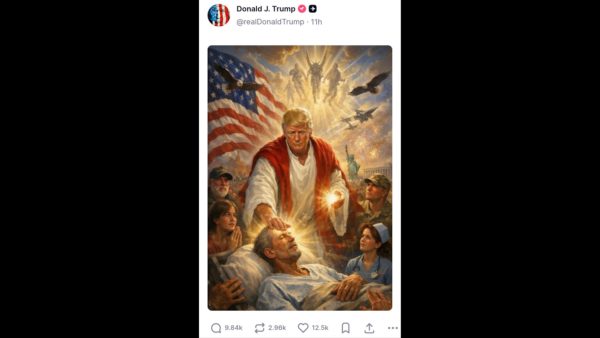
The post was deleted the following morning, and Trump was quick to explain it away.
“It’s supposed to be me as a doctor, making people better,” Trump said, speaking to reporters at the White House. But Trump’s attire seems more suited for “The Last Supper” than an operating room, and the resemblance to Jesus Christ is impossible not to view as intentional. Equating oneself with God or the son of God, especially in divinity or works, is condemned by most Christian denominations as blasphemous.
Even some of Trump’s own party members weren’t enthused by the message his image sent — Republican U.S. Rep. Mike Johnson of Louisiana, Speaker of the House and normally a staunch supporter of Trump, reportedly asked him to take the post down, and other Republicans also denounced it.
But some on the right still attempted to defend Trump’s post as a misunderstanding. Rev. Franklin Graham, a prominent American evangelical, argued the post didn’t include religious iconography.
“I do not believe President Trump would knowingly depict himself as Jesus Christ,” Graham said in an X post. “There were no spiritual references—no halo, there were no crosses, no angels. It was a flag, soldiers, a nurse, fighter planes, eagles, the Statue of Liberty, and I think this is a lot to do about nothing.”
While “spiritual references” is somewhat subjective, Trump’s savior-evoking attire and laying of hands glowing with light are difficult to excuse as medical imagery. A person clad in scrubs more typical of medical personnel can be seen in the bottom right of the image — it’s obvious Trump knows what a doctor looks like, and it’s hard to believe he didn’t understand the implications of the picture.
But Trump’s controversial post is just one of his many contradictions with Christianity. His post came in the middle of a larger conflict with Pope Leo XIV, who spoke out on Trump’s actions regarding the Iran war.
Following Trump’s Truth Social ultimatum that “a whole civilization will die tonight” in reference to Iran, Leo spoke out against the morality of the statement.
“Today, as we all know, there was this threat against the entire people of Iran, and this is truly unacceptable,” Leo said in an evening prayer service. “There are certainly issues here of international law, but even more than that, it is a moral question for the good of the people.”
In response, Trump’s vice president, J.D. Vance, warned the pope to “be careful when he talks about matters of theology” at a Turning Point USA event. Trump, less diplomatically, took to Truth Social again to excoriate Leo.
“Pope Leo is WEAK on Crime, and terrible for Foreign Policy,” Trump wrote. “Leo should get his act together as Pope, use Common Sense, stop catering to the Radical Left, and focus on being a Great Pope, not a Politician.”
His attack spurred many Catholics to defend the pope’s calling out of the war, including in a “60 Minutes” interview with three American cardinals. D.C Cardinal Robert McElroy believed the Catholic faith defined a “just war,” and the United States’s conduct in Iran necessitated a response from the church.
“In the Catholic teaching, this is not a just war,” McElroy said. “The Catholic faith teaches us there are certain prerequisites for a just war. You can’t go for a variety of different aims. You have to have a focused aim, which is to restore justice and restore peace. That’s it.”
There are over 50 million Catholics in the United States, and the denomination made up 20% of Republican voters in 2024, second only to Evangelical Protestants. The back-and-forth between Trump and the pope is highly unprecedented, as popes normally criticize U.S. policies rather than the leaders themselves.
The conflict is emblematic of how Trump’s aggressive attempts to bend the Christian faith to his personal agenda have alienated Catholic supporters. A Washington Post-ABC News-Ipsos poll found that 61% of Catholics surveyed had a negative reaction to the president’s comments on Leo and his Jesus image. And his decline in popularity isn’t confined to one denomination — support from white Evangelical Christians, another large voting base for Trump, has also dropped from 82% at the time of his election to only 64% in April 2026.
But whether Trump’s recent actions make any difference on election day remains to be seen, and it would not be the first time many Christians on the right have forgiven such behavior. In early May of 2025, Trump, who identifies as non-denominational Christian, shared an AI-generated image of himself in a mitre and papal dress following the death of Pope Francis, which was reposted by official White House accounts.
The reaction to the post was similar to his more recent Jesus-esque imagery, with Catholic groups such as the New York State Catholic Conference, which represents the bishops of the state, criticizing the post.
But no meaningful consequences followed — Catholic support for the president remained high, and American Catholics largely seemed to turn a blind eye to Trump’s mocking of one of Catholicism’s most sacred traditions. So is his Jesus imagery really enough to seriously turn his largest voting coalition against him?
Most likely not. As the pope’s opposition with Trump demonstrates, Trumpist policies — and the conduct of his entire administration — often fall short of supporting basic Christian values, but support from Christian Republicans has rarely wavered.
The Department of Government Efficiency, created during Trump’s second presidency, skeletonized one of the United States’s primary foreign aid programs, the U.S. Agency for International Development. After pausing funding soon after Trump’s inauguration in January, USAID, which has driven U.S. international aid since the Kennedy administration and provided access to education and healthcare for millions, was officially dissolved two months later.
The cuts were authorized as part of Trump’s “America First” initiative, as he claimed the foreign aid programs were “not aligned with American interests and in many cases antithetical to American values” in his first executive order targeting the programs. But if funding lifesaving HIV research, contributing to massive progress in maternal and child health and providing economic support in war-torn areas, all for less than one percent of yearly federal spending, is antithetical to Trump’s perception of American values, it paints an unflattering and decidedly non-Christian picture of his politics.
Additionally, the United States and Israel have begun a war in Iran, even as Trump made ending wars a core pillar of his presidential campaign (the White House made a press release declaring him a “President of Peace” in October 2025). The fighting has resulted in a deadly missile strike that killed more than 150 civilians and aforementioned genocidal threats against the Iranian people, while the Trump administration attempts to justify the unpopular war through religious rhetoric.
Secretary of War Pete Hegseth has been the figurehead of this warmongering, calling for violence and destruction in Iran and encouraging the military action under the “providence of almighty God.” In one of his monthly Christian prayer services, which are unique to the Trump administration and have featured guest speakers such as Christian nationalist pastor Doug Wilson, Hegseth preached “overwhelming violence of action against those who deserve no mercy.” The sermon reflects his almost fanatical idolization of the Crusades — his right biceps bears a “Deus Vult” tattoo, a term Hegseth called “the rallying cry of Christian knights as they marched to Jerusalem” in his book “American Crusade.”
“Do you enjoy Western civilization? Freedom? Equal justice? Thank a crusader,” Hegseth wrote. “If not for the Crusades, there would have been no Protestant Reformation or Renaissance. There would be no Europe and no America.”
But the comparison between U.S. military action and Christians’ reconquering of the holy land is not a virtuous one — the nearly 200-year medieval conflict saw terrible atrocities committed against civilian Jews and Muslims, as crusaders sacked cities and slaughtered noncombatants en masse. Hegseth’s twisting of Christianity to link the two does not reflect positively on U.S. military conduct, especially at a time when the United States has already come under scrutiny for war crimes against Venezuelan “drug boats.”
Take the words of Hegseth’s pastor, Brooks Potteiger, in his sermon as part of Hegseth’s first prayer service at the Pentagon May 5, 2025. “If our Lord is sovereign even over the sparrow’s fallings, you can be assured that he is sovereign over everything else that falls in this world,” Potteiger said, “including Tomahawk and Minuteman missiles.”
It was God, the service implies, that directed U.S. forces to missile strike the survivors of an alleged drug-carrying operation as they clung to the wreckage of their destroyed vessel that September. It was God, the Trump administration would say, that directed three U.S. Tomahawks to kill Iranian schoolgirls in a school in Minab six months later. The perversion of Christ’s teachings to justify U.S. wars is so blatant as to be absurd, and yet the Trump administration does it anyway.
The Trump administration’s militaristic, warped use of Christianity is only part of their campaign of religiously driven nationalism and xenophobia. Trumpism seeks to define the United States as an exclusively Christian nation, even as its policies are antithetical to the Christian virtues it supposedly seeks to return the country to.
Even Trumpism’s champion and namesake doesn’t represent the values he’s supposedly aligned with. Donald Trump’s first wife divorced him after she discovered his mistress, further citing “cruel and unusual treatment” as the grounds for their divorce. Later, Trump married that same mistress two months after she had their child, but divorced her following just a six-year marriage. And while married to his third wife, he had an alleged affair with pornographic film actress Stormy Daniels, then had his attorney Michael Cohen pay her $130,000 in hush money — an act that would eventually leave him convicted of 34 related felonies.
The Ten Commandments describe the morality of these acts succinctly — “Thou shalt not commit adultery” being fairly closed to interpretation — and the idea of marriage as a sacred, lifelong covenant is also central to the Christian faith. So beyond his rampant warmongering and hateful rhetoric, Trump has failed to uphold one of the most important institutions of Christianity. Why, then, do Christian Republicans allow this man to use their faith to represent his agenda?
By letting Donald Trump pervert the ideals of Christianity to serve his MAGA agenda, Christians have lost sight of the core tenets of their religion — love, forgiveness and justice, none of which Trump has shown the slightest hint of caring about. But with civilian killings, the death of U.S. foreign aid and personal attacks against one of Catholicism’s holiest figures, how much more does Trump need to do before the Christian right finally breaks with him?


