Skip to Content

Road to recovery: the battle against mental health stigma

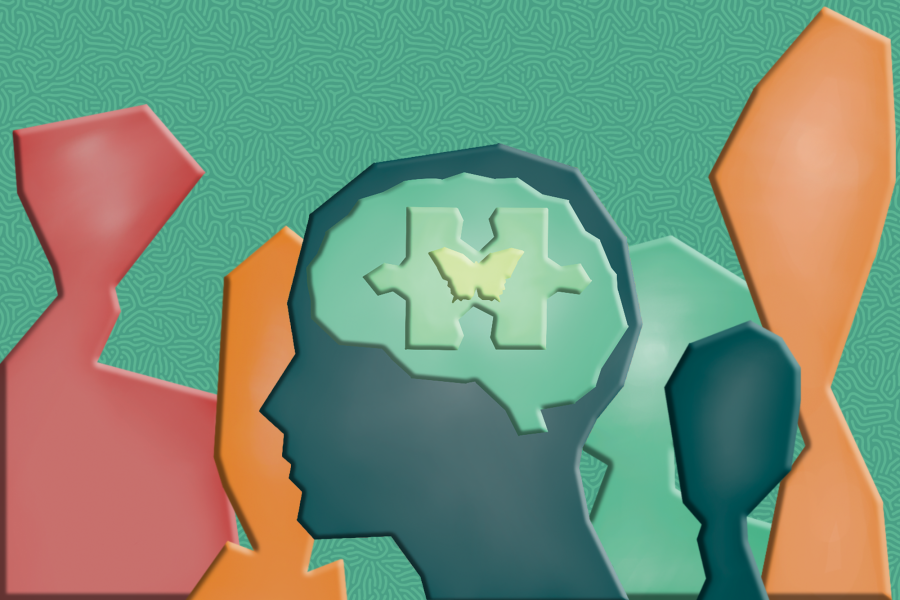
Despite the misinformation surrounding mental health conditions and neurological disorders, West High students continue to fight against stigma and advocate for a more supportive future.
West students continue to persevere despite the stigma surrounding mental health.
Zeke Williamson
Introduction
Introduction

“You’re so OCD.”

“I’m literally bipolar.”

“That’s psychotic.”

Psychiatric terms have become so embedded in everyday language that many students no longer notice the misuse. For decades, mental illness has been flattened into media tropes: the “crazy” love interest, the neat freak or the homicidal maniac. On-screen, online and in everyday conversation, complex mental health conditions are reduced to a set of stereotypes or quirks that distort how audiences understand real psychiatric disorders

According to the National Alliance on Mental Health, one in five Americans experiences a mental illness each year, while one in 20 experiences a serious mental health condition. For students navigating diagnoses ranging from eating disorders to attention-deficit hyperactivity disorder, the challenge is often not just managing symptoms but confronting the misconceptions attached to them.

Zeke Williamson

ADHD and autism spectrum disorder

After his diagnosis last October, Max Somerville 28 became one of the seven million American children diagnosed with ADHD, a condition that impacts focus and causes hyperactivity. Although it came as no surprise to him or his family, it marked the beginning of a new approach to managing symptoms he had navigated for years.

“I needed the diagnosis to start taking meds — it was really hard for me to focus,” Somerville said. “I’ve always shown signs of hyperactivity, which is a small sign of [ADHD], but in fifth grade, I had a hard time controlling my impulses. My parents sat me down [and] said, ‘You most likely have ADHD.’”

For Somerville, ADHD shapes both his struggles and his strengths. While focusing on unengaging material remains difficult, he hyperfixates intensely on creative interests, which he sees as an asset rather than a liability. 

It was hard for me to focus on things that didn’t interest me, but it was [also] hard to get out of things that do interest me, because I hyperfixate on the smallest things — video games, Legos, cards [and] things that are more creative,” Somerville said. “I want to pursue an artistic career; I feel like having ADHD would definitely help me.”

Sawyer Miller ’26 has lived with a similar experience since elementary school, when his ADHD first made sitting through uninteresting lessons nearly impossible.

“I was diagnosed when I was seven or eight,” Miller said. “For me, it was really bad to the point where if a lesson wasn’t interesting, I got up and left — walked all the way home. My mom was like, ‘Why are you here?’ And I was like, ‘It was boring. I didn’t want to do it.’”

Miller, who takes methylphenidate, describes the effects of unmedicated ADHD in simpler terms.

“The way I think of it is [that] I have a lot of energy, but I can’t take it anywhere. Unmedicated ADHD is like a dog; you can’t get the dog to go where you want it to. The dog will go wherever it wants,” Miller said.

In addition to ADHD, Miller has autism spectrum disorder, a neurodevelopmental condition affecting communication, social interaction and sensory processing. For him, the most persistent challenge is navigating environments built for neurotypical people. 

“My autism is a lot of sensory stuff — certain textures or noises make me feel not great,” Miller said. “A lot of people, especially in school, [are] talking. They all sound different, and they’re all at different levels. It gives me a really bad headache. I carry my headphones for that reason; I use music to make things sound the same, so it’s less straining, even if the music is really loud.”

Miller’s mother has been central to managing both diagnoses, helping him build structure and process emotions that feel overwhelming.

“My mom helps with schedules on a whiteboard in my room and alarms on my phone that tell me, ‘Hey, you should be doing this now.’ If I don’t have a schedule, I will do what I want when I feel like it, but when I give myself a deadline, I feel obligated to do it. That gives me a lot more motivation to get things done,” Miller said.

Miller has also developed communication strategies to navigate social interactions, including using “tone tags” — shorthand indicators like “/j” for joking or “/s” for sarcasm — added to texts to signal the emotional intent of a message. This helps others flag when he might misread their tone. Still, social situations require constant adjustment. Miller describes frequently masking his true feelings to avoid being misread as rude.

“There’s a lot of masking involved [in conversations], because some days I just want to go home. I mask how I’m feeling to not come off as rude more than I mean to. I’m just being literal,” Miller said. “Being literal makes more sense to me than sarcasm or beating around the bush. Some people interpret that as rude when I’m just saying that I want to go home.”

Both students push back against reductive portrayals of their diagnoses. Somerville notes that ADHD is widely mischaracterized as hyperactivity, when the condition involves far more complexity. Miller points to the media as a primary source of distortion.

“A lot of people think of autism as what they see in movies. It’s not that every time — usually in movies, it’s exaggerated for effect,” Miller said.

Miller’s advice is simple: ask for help sooner

“My struggle was asking for help in the first place. I used to feel bad asking for help because I thought it was making more work for other people,” Miller said. “Doing that is just digging a further hole. Asking for help, even a little bit, is a huge step.”

Bipolar disorder
Bipolar disorder

Bipolar disorder is often casually reduced to moodiness or indecisiveness, despite being a serious mental health condition characterized by intense emotional highs and lows known as manic and depressive episodes. One anonymous West High student was prescribed more than 20 medications before doctors landed on the right diagnosis. For years, she believed she only had depression.

“The lows were so low; the highs were so high. I always knew something was wrong,” the student said. “I was like, ‘This is not just depression. My brain is not correct.'”

Before receiving an accurate diagnosis, her symptoms frequently disrupted her daily life and strained her relationships. Manic episodes brought aggression and impulsivity; depressive episodes left her unable to leave her bed.

“I would be super aggressive — I would punch holes in the walls — and then I would go into insanely low states,” she said. “I had a really low point where I had to go to the hospital.”

Following several hospitalizations, doctors diagnosed her with bipolar disorder and prescribed lithium carbonate and Lamictal, a medication used to calm overactive nerves. Treatment stabilized some symptoms, but not all, and the collateral damage of her manic episodes lingered long after they passed.

“I ended up hurting my mom. That makes me want to cry knowing that. There were so many times where I was like, ‘I don’t want to hurt my family,’” she said. “I said to my mom, ‘If I could be different, I would. I don’t know what to do. This isn’t me.’”

Along with battling manic and depressive episodes, she notes that the people closest to her struggled to understand what they were witnessing and mistook her condition for teenage rebellion or ordinary sadness.

“My dad thought I was being rebellious, making it all up and being a teenager,” she said. “That’s one of the big [misconceptions] — ‘You just have hormones. You are going to get over it.’ But I knew this was not normal.”

That misunderstanding extends far beyond her family. According to the National Library of Medicine, “bipolar” ranks among the most commonly misused medical terms online — a trend she has watched play out on TikTok, where the word is frequently invoked to describe ordinary emotional swings.

“There are a lot of TikToks of people like, ‘Oh yeah, I’m manic,’ because they’re freaking out about a guy,” she said. “It hurts my heart [because] when you’re in a manic episode, you can’t fathom it. It’s inexplicable. It could be that you are going to run away. You could want to strip your walls of paint. You get angry.”

Through the misdiagnoses, manic episodes and the moments her family didn’t understand, one thing has stayed constant.

“People care about you. No matter what, even if it’s a teacher in the building, a therapist [or] a friend, there’s someone there at the end of the day,” she said.

Eating disorders
Eating disorders

Eating disorders remain among the most stigmatized mental health conditions, often reduced to stereotypes surrounding skinniness, vanity or self-control. In reality, eating disorders involve a complex relationship with food and body image, affecting nearly 31% of Americans at some point in their lives.

Among adolescents aged 13 to 18, anorexia nervosa — characterized by severe food restriction and overexercising —  is the third most common chronic illness. Although she was never formally diagnosed, Zariah Moore ’26 began her battle with anorexia in sixth grade. What started as food restriction escalated into seeking validation through weight loss and declining health

“It affected me long-term. It’s still hard now. I’m not in those same habits, but I have the same mindset, and I’m trying to work around that. Even as I was losing weight, I still thought I was overweight and that I needed to lose more, regardless of all my bones showing,” Moore said.

A Contemporary Pediatrics study found that only 20% of adolescents seek treatment for their eating disorder — and Moore was among the majority who didn’t. She began recovery only after recognizing the pattern herself

“What made me realize [I had an eating disorder] was the fact that I was seeking validation from losing weight and seeing the weight drop. At that point, I was like ‘Whoa, that’s not normal. I should do something about it,’” Moore said. 

Although friends and family noticed her eating behaviors, they stopped short of addressing them directly.

“Most of my friends would realize [my eating habits], and they would be like ‘Hey, you need to eat.’ I would wave it off and be like, ‘I’m fine,’” Moore said. “Nobody was like, ‘We need to talk about this; we need to figure out something to help you get better.’”

Additionally, Moore disagrees with how all eating disorders, including bulimia and binge-eating disorder, are understood publicly.

“Online, when anybody mentions eating disorders, they usually think of anorexia. They don’t think of the others, which are just as bad [and] affect people in different ways,” Moore said. “There [are] different ways you can feed into an eating disorder without being noticeable.”

Social media deepened that distortion: 40% of adolescents report that social media use caused them to worry about their body image, and Moore felt this during the COVID-19 pandemic.

“[This] was around 2020, when everyone was in a bad place,” Moore said. “I would look at other people and be like, ‘I want to look like that.’”

After the challenges Moore faced, her recovery came down to improved eating habits.

“The hardest part was actually eating,” she said. “I forced myself to eat two or three meals a day, because when I was in that state, I was eating one or less.”

Moore encourages others with disordered eating to seek support early — and go to family first.

“Reach out to family members more than friends, because family members can do more for you,” Moore said. “If you talk to family members and they help you reach out to somebody, it would be a lot easier.”

Obsessive-compulsive disorder

Every night before she goes to sleep, Haley DeMeulenaere ’28 has to set her phone in a specific spot on her bed and look at a specific point on her wall. If she doesn’t, she believes she’ll die.

DeMeulenaere is among one in 100 children and teens diagnosed with obsessive-compulsive disorder, a condition in which obsession — unwanted thoughts or fears — drives repetitive behaviors known as compulsions. She received an official diagnosis her freshman year, although her symptoms — once written off as superstition — had been present for years.

“I’ve always been superstitious — that’s always what we’ve pinned [it] on,” DeMeulenaere said. “My summer going into freshman year, it was so bad that I didn’t go to sleep until 3 a.m. one day because I had to sit and organize everything a certain way. Otherwise, there was going to be a house fire, my family [and] I were going to die. It was really hard because I didn’t know it was happening to me. You’re like, ‘What is wrong with me? Why can I not think normally?’”

The cleaning-and-organizing stereotype, DeMeulenaere stresses, is only one version of OCD. Her compulsions follow her into the most ordinary moments of her day.

“The same goes for driving. If I hit a bump [and] I do not circle back to go see it, it’s going to turn out that I just hit somebody,” DeMeulenaere said. “It’s something that I can’t stop, and it takes up a lot of time. I can try to resist them, but I just end up getting really anxious.”

To manage her anxiety, DeMeulenaere takes fluoxetine, which increases serotonin.

“Fluoxetine is like a cure-all. I used to hate it, and I still do, but unfortunately, it does help,” DeMeulenaere said. “You realize the thoughts are quiet, or you’re able to control yourself better. You know you may not feel things as vividly as you would without medication, which is something that I’ve had to overcome and get used to.”

Even with medication, the stigma persists. Peers, friends and teachers have treated her differently after learning of her diagnosis, creating a bind she hasn’t found a clear way out of.

“People see you differently when they know that you have a mental health issue. They see you as this sick person; a switch flipped in people’s brains. [But if] you don’t tell people, then they look at you like, ‘Why are you doing all these things? Why are you rewriting something on your paper five different times?’” DeMeulenaere said. “There’s this fine line between having to tell people and not, and you can’t just sit in the middle of it. You have to be on one side or the other.”

Within mental health discussions on social media, terms such as “OCD” have become a punchline as much as a diagnosis.

“A lot of people are like, ‘I’m so OCD; I just need everything clean.’ That’s the general stereotype, and that sucks,” DeMeulenaere said. “On TikTok, it’s used a lot for views. I like that it’s bringing awareness, but it frustrates me that people who have no idea what the spectrum is are saying that.”

DeMeulenaere emphasizes the importance of reaching out and receiving help, whether through medical treatments or therapeutic techniques.

“The first step would be talking to somebody so that they’re aware and can get you support,” DeMeulenaere said. “At the same time, remind yourself that you are not crazy. You don’t matter less because your brain works differently. You just think differently [from] other people, and that’s okay. That’s just something that you have lived with and that you will learn to live with, and that you know may encompass your everyday life, but you have to stick with it.”

I’m Glad You Stayed Project

In 2021, Abbey Schley ’22 founded the I’m Glad You Stayed Project as a local nonprofit organization that provides free resources and suicide prevention training. Schley describes how she was initially inspired to start the nonprofit after experiencing the suicide of her high school friend, Dylan Salge, in 2020.

“About a month after my friend Dylan passed away from suicide, I started an Instagram account called the I’m Glad You Stayed Project. I didn’t think that it would really become anything — I was just planning on making Instagram posts to give people inspiration to choose to stay,” Schley said. “Dylan was a student at West, so I wanted to get other students involved in suicide prevention.”

After experiencing the devastating loss of her friend, Schley faced struggles with her mental health, noting that support from therapists was not enough.

“It was very isolating. Dylan died during COVID. It was my first funeral — his visitation was my first time seeing someone [who] was no longer alive. He messaged me the night that he did it; I was the last person he spoke to, so I had a lot of guilt for a long time about why I wasn’t able to see sooner that he was struggling. It had a huge impact on my mental health,” Schley said. “I had two or three therapists at one time, and I went to two hospitals for my mental health — that’s when I realized I needed something like the I’m Glad You Stayed Project.”

Due to the stereotypes surrounding mental health conditions, a majority of struggling adolescents feel reluctant to ask for help with their mental health. Schley stresses the importance of reaching out and seeking support, whether it is from a trained professional, guardian or close friend.

“Dylan did not think that he deserved help because he had a roof over his head. His parents loved him. His parents did everything that they could for him, and he was still depressed. He thought, ‘Why do I deserve help more than someone who has every reason to be depressed?’” Schley said. “If he had known that so many people are in the same boat as him, that they have [support] and they’re still depressed, maybe that would have helped him. It’s important for people to know that they’re not alone.”

Schley notes the stereotypes that surround suicide, emphasizing that anyone can have struggles with suicidal thoughts.

“A lot of people messaged me after Dylan died and said that they had no idea that Dylan was depressed; they would see him every day in class or in the hallways. It’s invisible sometimes, and everybody thinks stereotypically like, ‘Oh, an emo kid is the one that’s going to kill themselves, not the super bubbly class clown personality [or] the athlete.’ That’s just not the case a lot of the time,” Schley said.

However, Schley believes that her organization would have helped Dylan before he passed; because of this, her suicide prevention training — the Question, Persuade and Refer — offers resources to support those in a similar situation.

“I think that all of these resources would have helped Dylan a lot, and everything was done out of what I wish I could have done for Dylan. The experience itself shaped me as a person, but also how the project was formed,” Schley said. “[QPR training] gives you the tools of actually asking someone, ‘Are you thinking of killing yourself?’ ‘Are you suicidal?’ That’s been proven to be a good question to ask people who are struggling, because it gives them a safe space — the training walks you through different scenarios of how to approach that conversation.”

The project also creates bracelets featuring the 988 hotline and other free products to promote mental health awareness. These items have become staples in the Iowa City community, with students and educators alike sporting them in the hallways. Through these resources, the IGYSP has made an impact not only in the local community but also all over the world.
The 988 hotline is always available for calls concerning suicide prevention. (Zeke Williamson)

“I’ve gotten DMs about how even just having our pamphlet has been really helpful to people; they’ve used the pamphlet to get their friend help, which is the main thing that I wanted out of this,” Schley said. “People [who] take QPR training come to us and say, ‘I have a cousin, sibling, son or daughter [who] is struggling, and QPR was so helpful.’ It’s opening up the conversation around mental health and suicide — that it’s okay to not be okay — and that people [shouldn’t be] afraid of the stigma.”

Schley stresses that although a friend, family member or trusted adult should not be entirely responsible for keeping someone’s mental health stable, it is important to show support. Additional resources include calling 911 if the person is having an immediate crisis, or calling 988 — the suicide hotline — if they are considering committing suicide.

“If it’s something where they’re like, ‘I’m really depressed. I’ve thought about suicide, but I haven’t made a plan,’ you can guide toward 988, a school counselor or a trusted adult who will help them get to a professional or someone to talk to who will keep them safe,” Schley said. “It’s important to remember that as a teenager, you can’t be responsible for keeping people alive. Do what you can and get them to people [who] can help them with resources.”

Donate to West Side Story
$1600
$2000
Contributed
Our Goal

Your donation will support the student journalists of West High School. Your contribution will allow us to purchase Scholarship Yearbooks, newsroom equipment and cover our annual website hosting costs.

Navigate Left
Navigate Right
Donate to West Side Story
$1600
$2000
Contributed
Our Goal