



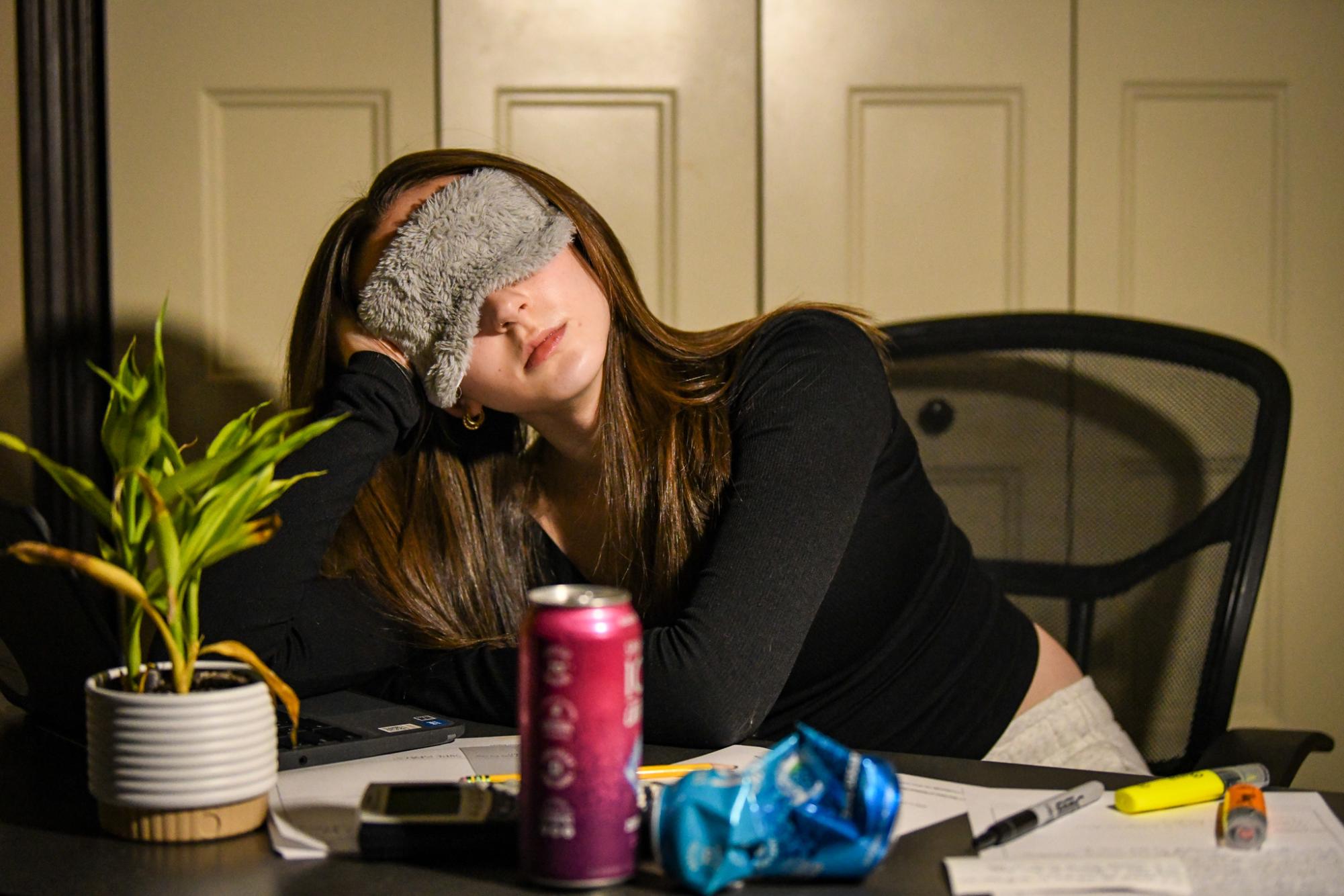
After tiring school days, high schoolers often juggle responsibilities for sports practices, jobs or clubs. Arriving home, they face the task of finishing homework and staying up late studying for upcoming assessments, which can cause insufficient sleep.
The National Sleep Foundation defines sufficient sleep as 8 to 10 hours for adolescents. Despite this recommendation, a December 2025 survey of 170 West High students revealed that only 9.6% of students receive the advised range. Lydia Evans ’26 is one of many West students who gets less sleep than recommended.
“[On] a typical school night, [I get] seven to five hours [of sleep],” Evans said. “If I go to bed at midnight, that’s a good night, because it’s usually one to two [a.m.]”
Evans’ sleep habits reflect a larger issue among teenagers: not getting enough sleep. Nationwide trends reflect this, with less than 13% of high schoolers in the United States meeting the recommended amount of rest, according to Stanford Medicine. The Cleveland Clinic finds that a lack of sleep results in increased irritability, depression, anxiety and a less effective immune system. Throughout high school, Evans has noticed that her poor sleep habits affect her well-being.
“I get more stressed; I have more trouble waking up,” Evans said. “I’m more absent-minded and more prone to [sleeping] in class.”
Cramming, or rushed studying for an upcoming exam often late at night, is a common culprit of sleep deprivation. Both long- and short-term memory functions are strengthened during sleep; a loss of rest from cramming negatively impacts memory retrieval, leading students to forget the information over longer periods. Ella Krupp ’27 describes her personal experience with cramming.
“My psychology final was on Thursday; I hadn’t learned any of the material by Wednesday, [so] I stayed up,” Krupp said. “I usually don’t remember anything [after cramming]. I take the test, immediately forget [the material], and I have to study for the final. I’m like, ‘I don’t even remember learning this.’”
Because of its proven downsides, Jeff Conner, an AP Chemistry teacher at West, discourages his students from cramming.
“We have this end-of-year [AP Chemistry] exam, and the goal is to retain that knowledge. [Cramming] puts the entirety of the stress at the end of the unit, rather than trying to spread it out over a longer period,” Conner said.
While sleeping, a person’s brain rehearses learned information, strengthening neural connections. Consequently, rushed learning results in weaker connections and lasting negative long-term memory effects. Krupp notes that cramming hinders her academic performance, which leads to more cramming.
“I’m in a cycle of cramming. Cramming for [one class] pushes off the next thing,” Krupp said. “I’m a major procrastinator, and that’s the root of all my [cramming].”
When a person crams, they retain less information because of decreased Rapid Eye Movement sleep. REM sleep occurs when people enter a deep sleep, triggering dreams. Entering this stage provides multiple benefits, including improved memory, problem-solving skills, brain development and mood regulation. Consequently, getting less REM sleep can affect memory retention. Camille Crossett, an AP Psychology teacher at West, describes the effects of cramming on REM sleep.
“Cramming is proven [not to] be the most effective version for studying, because [the information] doesn’t retain well. You get longer stretches of REM sleep as you go through the night; you might have a longer stretch towards the six- [to] eight-hour mark,” Crossett said. “While you might be getting four hours of sleep versus eight, you really might get a quarter or less of the REM sleep that you need. Most of it happens in the back half, [which] can really impact your brain functions.”
Mark Dyken, a neurology professor at the University of Iowa, echoes Crossett, explaining how a research study performed by a colleague showed the impacts of decreased REM sleep on retention. The study involved having graduate students perform a motor task — a physical activity requiring coordination of the muscles, nervous system and voluntary brain control — to learn a specific type of movement during the day. His colleague then monitored their brain activity at night, waking the students when they entered REM sleep.
“The next day, when [he] had [the students] review that motor task, they couldn’t remember [it] at all,” Dyken said. “The reduction in REM sleep may hurt your consolidation of memory when you’re cramming.”
Beyond academics, global events like the COVID-19 pandemic have altered sleep habits. From January to June 2021, roughly 25% of high schoolers reported five or fewer hours of sleep on an average school night, according to the Centers for Disease Control and Prevention. This is often a sign of sleep insomnia, or difficulty falling asleep, staying asleep or waking too early. A 2021 study published in Sleep Medicine found that insomnia rates doubled across 13 countries since the start of the pandemic.
One factor contributing to this trend is increased screen time. A 2020 Adolescent Brain and Cognitive Development study found that 10- to 14-year-olds reported more than seven hours of daily screen use, a 3.8-hour increase from pre-pandemic levels. Using screens before bed disrupts circadian rhythms, or the 24-hour internal clock driving sleep-wake cycles. This is because the emitted blue light suppresses the release of melatonin, the hormone that promotes sleep; normally, melatonin levels are low during the day and rise at night. Crossett explains that screens’ light can disrupt this pattern.
“Looking at screens before sleep creates false brightness, which tricks your brain into [thinking], ‘It’s daytime. I don’t need to sleep,’ [so the brain] doesn’t produce melatonin. That can really impact your ability to fall asleep,” Crossett said.
A 2018 study by the National Institutes of Health found that over 60% of American children and teenagers use a screen before bed. Evans attributes her insufficient sleep primarily to the addictive nature of social media.
“The biggest thing that impacts my sleep is TikTok, because it’s easy to keep scrolling. It’s a really hard cycle to break out of, because that dopamine feels good [at] the moment,” Evans said. “Then, an hour passes by, and it’s like, ‘I wish I hadn’t done that.’ If I am on my phone scrolling and then go to bed, it takes me longer to fall asleep than if I had my phone put away 30 minutes [before bed]. The blue light definitely [keeps] my brain awake.”
To combat the effects of blue light emissions from increasing technology use, eyewear companies created blue-light-blocking glasses. Surging in popularity during the pandemic, over two million pairs were sold in 2020. However, a 2023 review by the National Institutes of Health revealed no reduction in eye strain symptoms when using blue light lenses compared to regular lenses.
Excessive screen time not only causes wakefulness, but also reduces sleep quality and duration. To improve nightly routines, Dyken recommends less screen time and pre-sleep habits, such as turning off devices, taking a shower or brushing one’s teeth.
Another common disruption to circadian rhythms is caffeine, a neurological stimulant. Medical News Today reports that 83.2% of teenagers consume caffeine regularly, making it the most popular psychoactive substance worldwide. According to Crossett, caffeine has multiple side effects, including elevated heart rate and blood pressure, interfering with some medications and negatively affecting sleep.
“Caffeine speeds up your nervous system. While it is a [milder] stimulant, a lot of people will feel its effects last four to six hours,” Crossett said. “If you’re drinking caffeine at 6 p.m. and trying to go to sleep by 10, you can still have that buzz in your system. That can still keep you from sleeping or sleeping as deeply.”
Melatonin sleep medication is a common solution for teenagers facing sleep issues. Among the 170 West students surveyed, 13.4% of students reported taking melatonin. However, this medication can cause side effects such as daytime drowsiness. Krupp recalls an experience when taking melatonin before an exam.
“If I take melatonin, you cannot wake me up. Before the AP Human [Geography mock] final, I took melatonin the night before; I slept through the whole thing,” Krupp said.
Daytime sleepiness can result from taking sleep medication too close to bedtime or exceeding the recommended dose of two milligrams. To minimize drowsiness, the National Health Service recommends taking melatonin one to two hours before bed.
Although widely used, melatonin’s effectiveness varies. Dyken notes possible differences of the bioavailability of melatonin, or the proportion that enters the body’s circulation.
“Sometimes the bioavailability and different forms [of melatonin] that you can get at the drugstore [are] much more than your body would have produced. You don’t know what you’re getting over the counter,” Dyken said.
Alongside the challenges in balancing busy schedules and sleep, Conner advises students to prioritize what is most important to them in school; this could include accepting a lower grade or dropping an extracurricular.
“Don’t take on too much. Many students [are] overwhelmed because they have so many things on their [plates]. Some students [are] taking five AP classes, [are] involved with athletics and do other extracurriculars; it becomes an impossible task for them to do all of that and get a good night’s sleep every night,” Conner said. “Students are going to have a better experience if they [focus on] the things that are most important to them.”