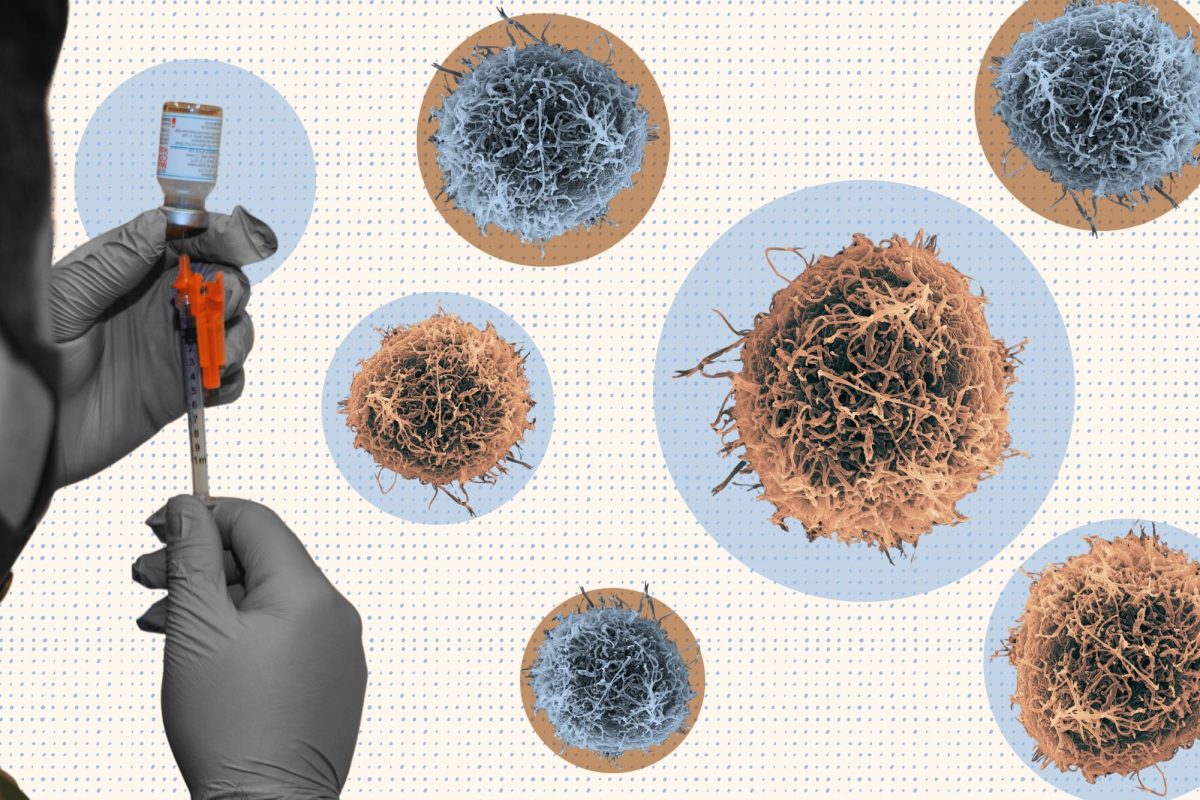



In Libya, a teenage boy schedules a doctor’s appointment. On the pre-exam form, he checks off “family history of diabetes.” On the other side of the world, a young woman in the Midwest reads through an article claiming that her environment increases her risk of cancer. In Iowa City, college students step into class to examine these patterns in an emerging field of science: epigenetics, the study of how the environment affects one’s genes.
Epigenetics affects gene expression — or how a gene’s information becomes a functional product — which influences behavioral and health outcomes. For West students, these factors may stem from local environmental changes or historical events decades earlier, such as the Dutch Hunger Winter or historical hunger strikes, shaping family gene pools. Together, these forces combine to create different genetic factors and conditions.
Dr. Marie Gaine, assistant professor of pharmaceutical sciences at the University of Iowa, notes that epigenetics is influenced by numerous factors that continue to change throughout one’s life
“Epigenetics [is the study of] modifications that occur on top of DNA. It is associated with the environment because it’s dynamic, meaning that it changes throughout our lifetime,” Gaine said. “There are a lot of things that change our epigenetics starting in utero: the prenatal environment, our immune system, early life medications that we take [and] aging.”
These changes in environment impact people across the Midwest. With more than 80% of Iowa’s land devoted to agriculture, its water sources are heavily affected by agricultural runoff, specifically with chemicals in fertilizers and pesticides. These include polyfluoroalkyl substances — PFAS — known for their lasting presence in water sources. As of 2023, the Iowa Department of Natural Resources estimates that roughly half of Iowa’s water sources contain PFAS.
A 2025 University of Arizona study found that exposure to carcinogens — cancer-causing compounds such as PFAS — can alter gene expression. This increases risk of cancer, neurological disorders and autoimmune diseases in families through continuous exposure. In October 2025, skin cancer risk for young adults in the Corn Belt was found to be 35% higher for men and 66% higher for women than that of other regions.
Adam Salem ’26, who has researched cancer at the University of Iowa, witnesses the impact of Iowa’s agriculture on the local environment. He believes that such exposure to fertilizers negatively impacts local communities.
“In terms of pollution and the environment, Iowa is not doing its best. We make a lot of corn, have a lot of pigs, grow a lot of soybeans. The problem with that is it creates runoff that goes into local water streams,” Salem said. “Lake MacBride is [extremely] toxic and polluted, and Iowa is one of the largest nitrogen filters in the entire world because of how poor its water quality is. Growing up here, your water quality is going to be very different [compared to] that of a beach in California.”
Nitrogen is a crucial plant nutrient found in fertilizers and pesticides. Due to its importance in agriculture, farm states filter high amounts of nitrogen from drinking water. In 2017, the Environmental Working Group found that nitrate — a compound of nitrogen and oxygen — from agricultural runoff may raise cancer risks through its eventual contamination of drinking water, especially in agricultural-dependent states like Iowa.
Under the Environmental Protection Agency, legislation such as the Clean Water Act and Safe Drinking Water Act cap the release of pollutants into U.S. waters and protect the safety of American drinking water. However, such legislation does not account for large-scale point-source agriculture, such as concentrated animal feeding operations. Salem ultimately believes that, to improve the environment by decreasing agricultural runoff, more government intervention is necessary.
“The [current] administration needs to do a better job at focusing on farm-related mandates [that target] increasing runoff into bodies of water that are used for drinking,” Salem said. “There needs to be a larger focus on decreasing the cancer rate.”
While local environmental factors play a role in epigenetic makeup, the study’s scope extends far beyond regional borders. In particular, immigrants face different health outcomes due to historical events across the world.
Ahmed Elbeshti ’28 immigrated with his family to the United States from Libya in 2014 for improved family healthcare. Located on North Africa’s Mediterranean coast, Libya’s political climate has been turbulent for decades due to military conflicts. The country’s humanitarian crisis has escalated into Arab Spring protests, civil wars and intense military intervention. Elbeshti believes that the political environment his parents grew up in influenced their mental processing.
“[My parents grew] up in a time when the political [situation] was bad. Anytime my dad tried to go to the mosque, the president at that time was like, ‘We might go in there and [arrest] you just for praying,’ so there was a lot to be worried about,” Elbeshti said.
Studies published in Global Pediatrics and Frontiers in Public Health indicate that these conditions can affect gene expression in the children of affected parents. Similarly, Nature recently published an analysis of intergenerational epigenetic markers that highlights stress in conflict. The study also shows that these genes can echo through generations, affecting how descendants respond to stress, even if they were never exposed to the original conflict.
Additionally, Elbeshti notes that his family has a history of Type 2 diabetes. He believes their customs in Libya, including diet, may have contributed to this pattern.
“In Libya, [my family organized] a lot of gatherings, because they all lived next to each other; my dad described them and their friends [as] all [being] in the same neighborhood, and they’d hang out every day and have dinner at one of their houses,” Elbeshti said. “Libyans like to make and eat a lot of food.”
A 2019 National Institutes of Health study supports this idea, finding that diabetes and metabolism are closely linked with environmental factors and habits. The study also highlights that exercise and diet play major roles in eating and metabolism disorders. Gaine acknowledges this idea, citing the effects that a diet has on health.
“Our diet really can have a huge impact. There have been links to both obesity and anorexia as two extreme examples [of impacts],” Gaine said. “None of these [changes] are in isolation, so you can have seemingly independent factors that could combine to overall increase your risk for a certain disease or phenotype.”
Aligning with Elbeshti, the International Diabetes Federation reports that 15.8% of Libyan adults have diabetes as of 2025, compared with 11.1% worldwide. In the Middle East and North Africa, this number is forecasted to double by 2050.
Although epigenetic makeup is shaped by generations of history, Salem agrees that education about family health patterns is the best way to reduce risk. Specifically, if individuals with high susceptibility to disease can make informed decisions through public health intervention, they can reduce future disease incidence.
“As a teenager, if you’re aware that your eating habits have a greater impact on whether you face [certain conditions], you can make those decisions in your life far earlier than if you wait to find out,” he said. “Preventative care is one of the most important actors in medicine — it’s one of the easiest ways we can stay safe without having to wait until something bad happens.”
Gaine echoes Salem, claiming that a mix of prevention, intervention and education is key to reducing susceptibility to intergenerational disease.
“Education would be paramount, but learning about your epigenetics is probably not as important as learning about what’s causing these changes,” Gaine said. “We [need] to learn more about how [responsible eating habits] make you healthier.”
Grandview Research projects the epigenetics therapeutics market will reach $4.9 billion by 2030, as the field continues to experience breakthroughs. Gaine expects the field to expand as scientists learn to use epigenetics to predict health outcomes.
“What’s making me most excited is our ability to use epigenetics to predict health, metabolism and certain immune responses,” Gaine said. “This collection of data points could be used to get a lot of [information] about a person — that’s where the field will move towards.”