

Senior spotlight


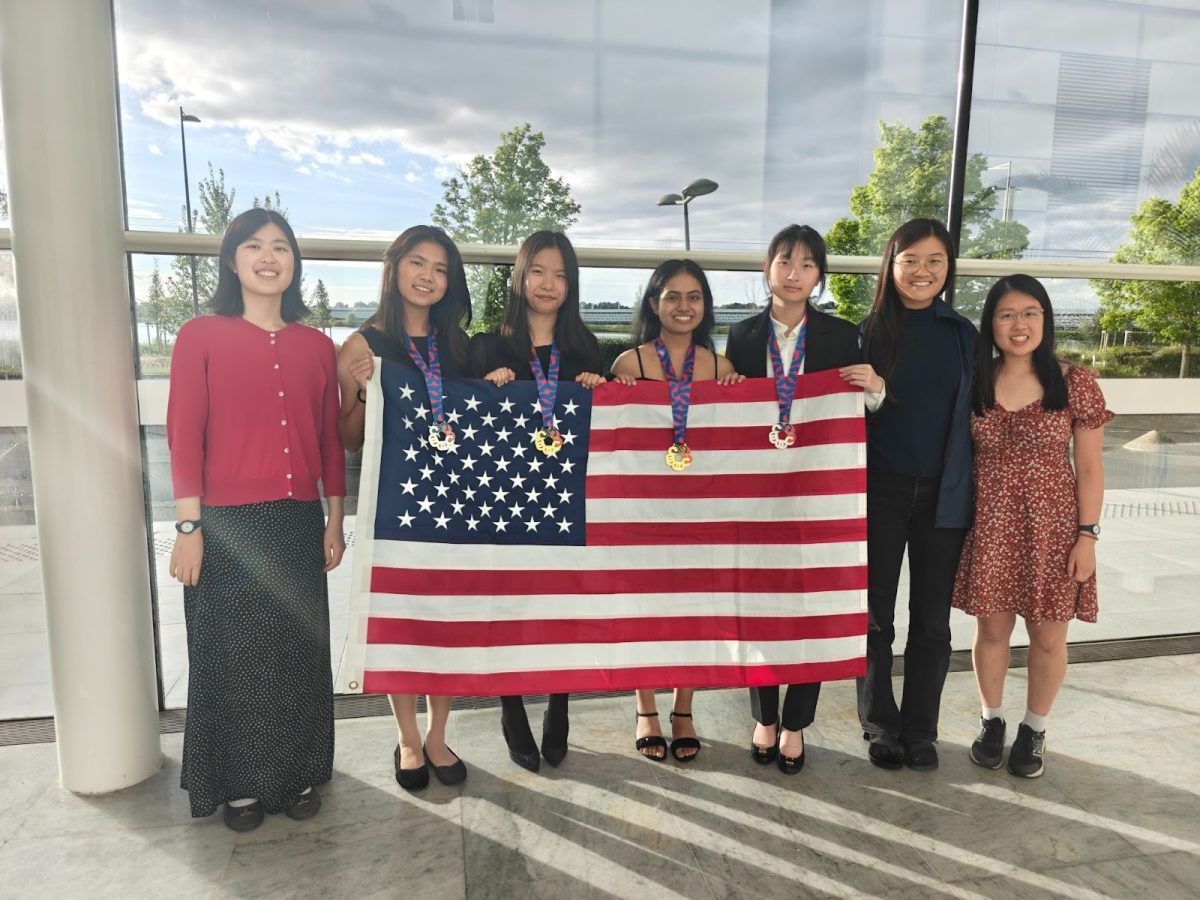
Not many people can say they have a world gold medal for math, but Catherine Xu ’26 can. While other West High students were preparing for their upcoming Advanced Placement tests, Xu was in Bordeaux, France for the European Girls’ Mathematical Olympiad.
Xu’s background with math goes back far. From practicing multiplication to algebraic expressions, Xu’s parents gave her problem after problem to sharpen her skills. By third grade, she was participating in math competitions like Math Kangaroo. By fourth grade, she was accelerating to more advanced classes. In sixth grade, she took a year off from in-person school to devote herself to the subject and competitive math.
“I remember when [my dad] gave me the problem Gauss had — adding one plus two plus three, all the way up to 100 — and I sat there [frustrated], but then he showed me that you can pair up the ends. That’s kind of how I got interested [in competitive math],” Xu said.
Spending hours on complex math isn’t for everyone, but despite the volume of content she was tackling, Xu found joy in it. She compares it to reading a book that one might find boring at first, but eventually becomes hooked on. Later, Xu joined West’s math team, Mu Alpha Theta, which recently secured their 22nd straight state championship. She also attended the Mathematical Olympiad Program for two years, a selective program gathering 60 of the top American high school math students to train for the International Mathematical Olympiad.
Even though she devotes most of her time on math, Xu also spends time mastering other subjects, such as English, history and chemistry, adopting a multidisciplinary approach.
“A lot of people in math tend to dismiss writing and history. They [assume]: ‘Why would I ever need writing or history?’ But I think they’re really important things to learn, to know why your work is actually important,” Xu said.
Xu will be attending the Massachusetts Institute of Technology in the fall, double-majoring in AI decision-making and math. In the future, she hopes to explore this intersection to rationally build AI at a steady rate.
“There are four major routes for [mathematicians]. You can go do quantitative finance on Jan Street, you can do academia, you can do tech. Now, there’s a new branch of tech, which is AI,” Xu said. “AI is progressing really fast, and humans are inefficient compared to AI. So what might happen is that AI misaligns itself so it doesn’t have to listen to us.”
Outside of her own academic pursuits, Xu works hard to empower young female mathematicians through her organization, the Iowa Chapter of Integirls. Xu cites that STEM can often be daunting for women, and hopes to continue Iowa City’s strong legacy of math in the next generation.
“[Being involved] in math is definitely difficult in middle school, because I feel like there’s still [separation between] girls and boys. The boys are talking about their own thing, and girls are not interested in these things, so it’s difficult to branch out,” Xu said. “I had female role models, but I can imagine it’s really discouraging if everyone else is a boy and you have no one to talk to, and there’s not a person there for you. I think it’s getting much better locally, because I’ve noticed there are a lot of girls in middle school doing math now, which is amazing.”
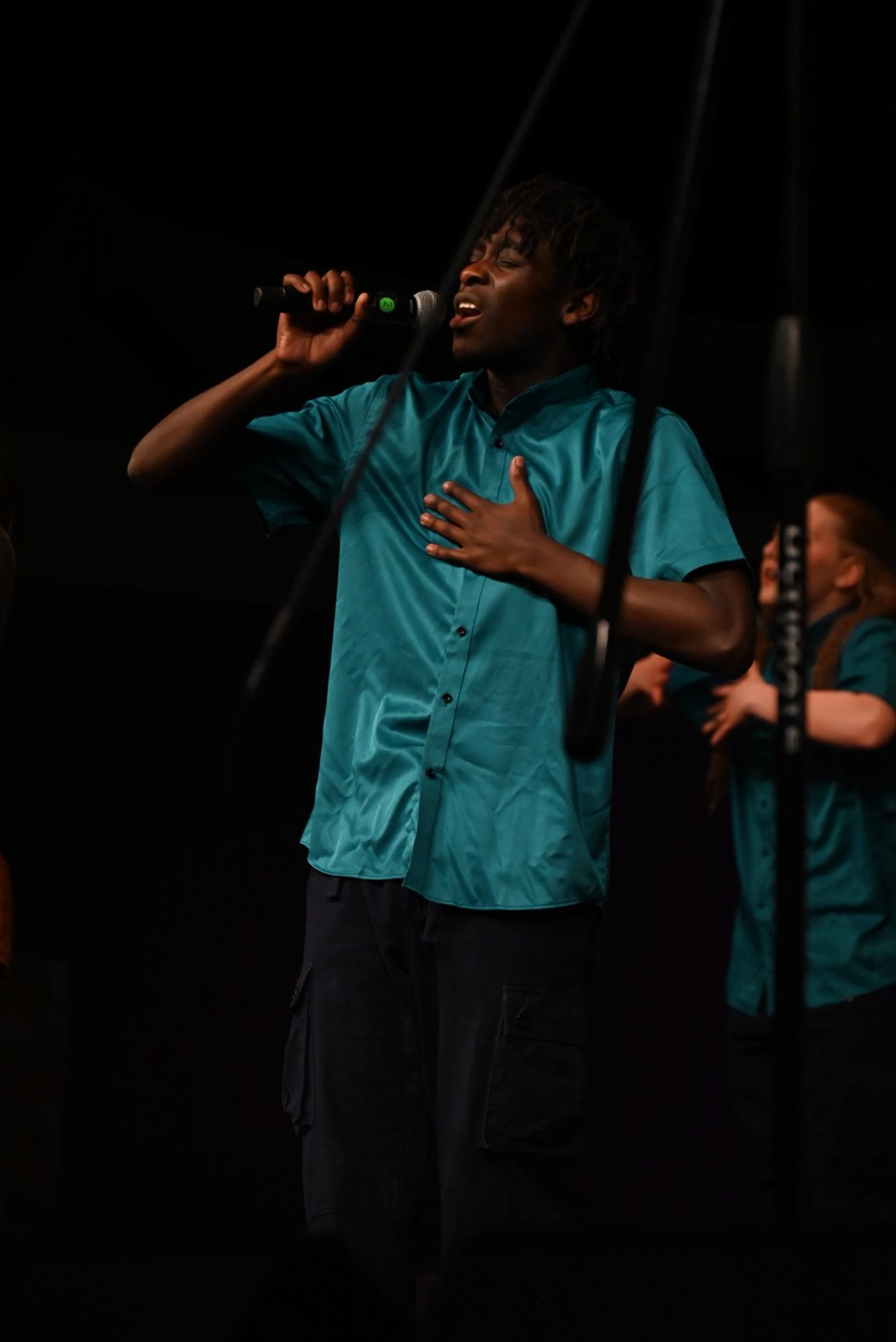
Whether drumming in the bandroom, fiddling with his synthesizer or sporting a pair of Airpods between periods, Derick Doresca ’26 rarely goes a day without music.
After being introduced to the drums by his dad at age three, Doresca picked up piano in first grade. By fifth grade, he joined Weber Elementary School’s band alongside his peers. Towards the end of junior high, Doresca joined the Northwest Middle School jazz band and started taking drum lessons.
“That was the first time I ever played drum set with other people. And I was like, ‘This is so much fun. I love this,’” Doresca said.
In high school, Doresca widened his musical horizons. In his sophomore year, he was introduced to Dr. David Haas, one of West’s choir directors. He started taking Haas’s digital music production classes and experimenting with producing his own music.
“I just grabbed my computer one day and started making beats,” he said. “I would talk to Oliver (Miller ‘25) about it, and through him, I met Dr. Haas, and then I started working with Dr. Haas a lot, and I took all his classes.”
Haas also convinced Doresca to join West’s choir and show choirs. As a senior, Doresca was a part of Concert Choir and West’s varsity show choir, Good Time Company.
In his senior year, he also auditioned for Iowa’s All-State band. After months of preparation, he became one of eight percussionists to perform at the festival.
“All-State was a crazy, cool experience. The preparation itself is worth it because the process of auditioning and learning the material makes you a lot better as a musician,” Doresca said. “And auditioning is scary; that actually is probably one of the only times I’ve had genuine stage fright.”
Outside of school, Doresca is also a member of two bands. One with West seniors pianist Sean Kearney and bassist Solomon Shaffer, unofficially called “Trisha Paytas.” The trio has played a couple of gigs, including one in Cedar Rapids and closer to home at events hosted by West’s student-produced music club, Cadenza.
“It’s a different type of thing when you’re coming together with your peers to make something instead of having a director teach stuff to you. I think it’s really good to branch out and do smaller ensembles,” Doresca said. “It’s a lot more of a creative thing, because we choose what we want to play and we just learn it on our own. So it helps with independence and learning how to play with others”
His other band, called “Don’t Fret,” is more recently formed, and instead of playing the drum set, Doresca sings. He performs with juniors Jack Rippentrop, Lea Abou Alaiwa, Miles Richardson and Elsie Gross.
“I love performing. It’s like, one of my favorite things, no matter what type of performance, I just like being on stage has always been so much fun to me.”
Next year, Doresca will be a member of the University of Iowa’s jazz program as he studies music.
“I don’t know if I want to keep pursuing digital music, like producing and stuff like that,” he said. “I’m trying to keep my options open, because I really like jazz and I love playing drum set, but I also like singing and producing. So there’s a lot of different roads I could take,” Doresca said.
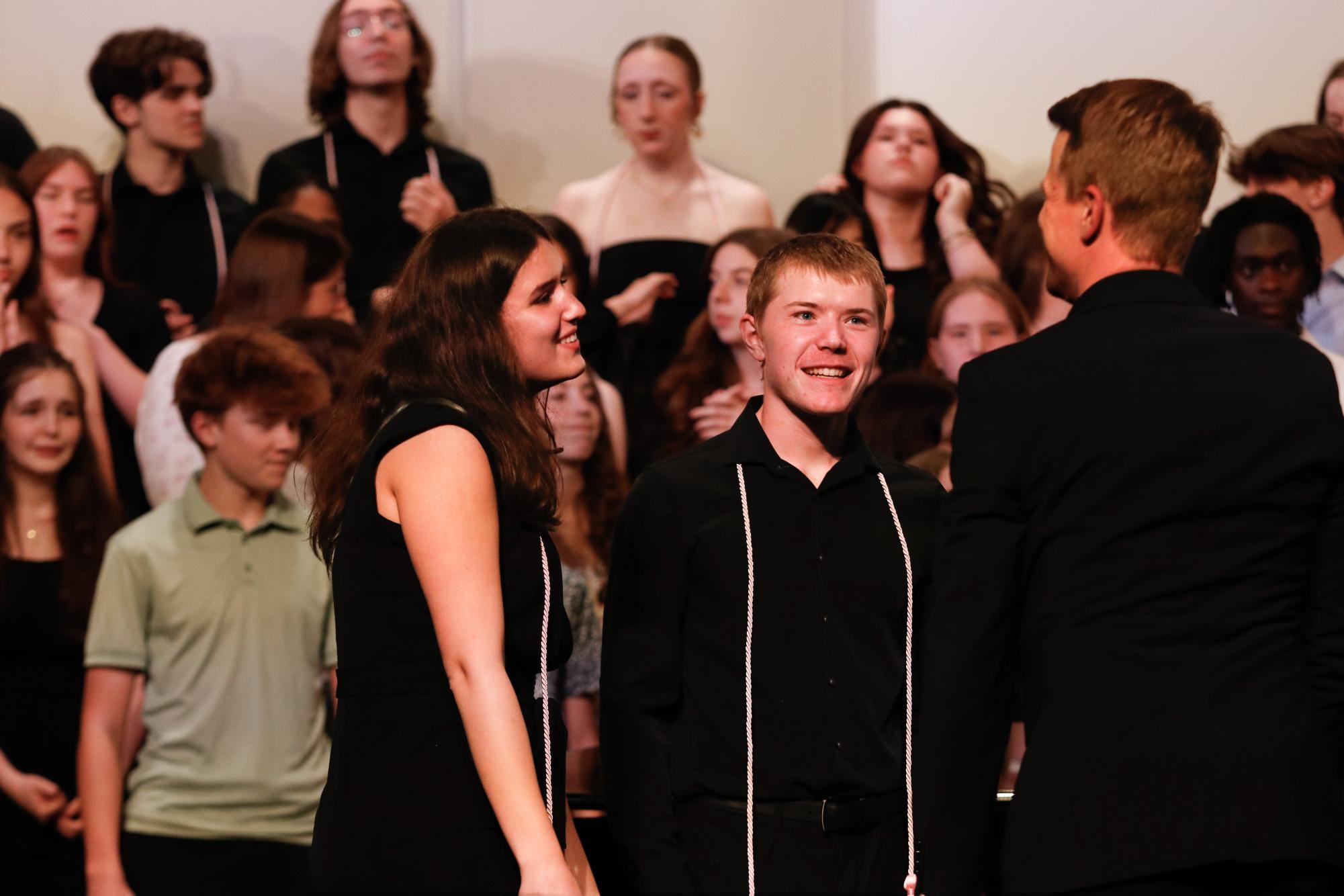
When Gabriel Conrad ’26 was a child, he wanted to be an astronaut. Years later, he’s not ruling it out as a possibility. He recalls sitting at his kitchen table and asking himself how, exactly, one goes about becoming one.
The answer came to him while listening to a speech by Arizona senator and former astronaut Mark Kelly: military aviation.
So last summer, Conrad found himself learning how to fly a plane at the Aim High Flight Academy, where he learned how to become an Air Force officer and gained 15 hours of flight experience.
“[The Academy] tossed me right into it. It was like being thrown into the deep end of a pool, because it is scary, but definitely rewarding,” Conrad said. “Especially after I practiced a bunch, the flight instructors learned to trust that I knew what I was doing; [I would] take off and land on my own with no input.”
The Air Force demands technical, physical and mental skills in order to be successful. When learning how to fly airplanes, Conrad recalls learning various technical skills as a part of his training.
“We did a lot of studying in classes, so I can learn how to fly on a given day with a bunch of different variables, like barometric pressure, humidity, elevation and pressure at a certain altitude. That way, we can calibrate our instruments, because they’re sensitive,” Conrad said.
Still, Conrad cites that soft skills are equally important to the technical skills. He looks forward to growing holistically in the Air Force.
“I’ll be able to grow as a person in the Air Force. A big reason why there’s a lot of people that were in the military that are in prominent positions in business and government is because they gain a lot of soft skills, like leadership and communication,” Conrad said. “A big part of what they look for when you’re applying to a service academy is a little ‘sprout’ of these soft skills. They want to ensure that you’re able to nurture these skills and grow to [your] full potential.”
Conrad is also an Eagle Scout — the highest rank that can be reached in the Boy Scouts of America program. Throughout the program, Conrad has logged hundreds of volunteer hours.
“Scouting is a big part of my outlook towards service, because in scouting, you serve people in your community and serve your fellow scouts,” Conrad said.
Although Conrad has only just made it to the Air Force, he has faced challenges to get to this point. Originally inspired by role models and many of his family members, Conrad has a strong support system that fuels him to keep pushing.
“My uncle was the pilot that inspired me, then Mark Kelly initially pushed me in that direction. Then, when I didn’t have the motivation to do something, my dad got me to do it. He [got] the ball rolling down the hill,” Conrad said.
Conrad said he doesn’t know where his future will take him. Whether it’s NASA or the private sector, he is open to many possibilities. His next step is the United States Air Force Academy in Colorado, which he will attend in the fall.
“[The Air Force] is one of the biggest challenges I could embark on,” Conrad said. “I looked for the biggest mountain [and said], ‘I’m gonna climb that.’”
-
 FeatureBetter understanding Iowa's water quality crisis
 -
 FeatureRethinking diets: how West utilizes different eating habits
 -
 FeatureDespite setbacks, Scott Matsen ‘26 fought to achieve his football dream
 -
 FeatureSenior Columns: Class of 2026
 -
 FeatureThe formula for fun: how Renee Gibson came to West High
 -
 FeatureRoad to recovery: the battle against mental health stigma
 -
 FeatureGoing greek: behind the scenes of University of Iowa sororities and fraternities
 -
 FeatureStanding in the spotlight: Luke Reimer ’27 shares his musical journey
 -
 FeatureThe concussion journey of Amaia Martinez
 -
 FeatureFarming diversification for cleaner water and economic resilience: learn about Chris Jones and his campaign
 -
 ProfilesReach for the sky: Thora Schimmel's journey to find her voice
 -
 ProfilesPedal to the metal: how Axel Brandsmeier ’29 found success
 -
 ProfilesEva Jara’s journey through injury, loss and success
 -
 ProfilesDynamic duos: A glimpse into West's friendships
 -
 ProfilesMore than an exchange from Spain: a student finding home away from home
 -
 ProfilesCollector's cache: West students show off their collections
 -
 ProfilesConnecting the community: how Taleen Rahhal's mission has made an impact
 -
 ProfilesPerfectly pitched: Nathan Butler '27
 -
 ProfilesQ&A with transfer Cyan Blommer ‘29
 -
 ProfilesA chapter into the lives of the Coralville Public Library staff
 -
 ShowcaseIowa City Community School District announces Interim Superintendent
 -
 ShowcaseThrough the lens: jazz bands perform downtown
 -
 ShowcaseWest orchestras say farewell to seniors at final concert
 -
 ShowcaseThrough the lens: West bands' spring concert
 -
 ShowcaseA look back on 2025-26: moments of excellence
 -
 ShowcaseBudget cuts, loans denied and resignations: A deep dive into the ICCSD’s current financial state
 -
 ShowcaseNow trending: mental health
 -
 ShowcaseDiamond in the rough: how technology is shaping baseball and softball
 -
 ShowcaseWest High baseball shuts out Davenport West 3-0
 -
 ShowcaseWest track and field competes in state meet


Your donation will support the student journalists of West High School. Your contribution will allow us to purchase Scholarship Yearbooks, newsroom equipment and cover our annual website hosting costs.