


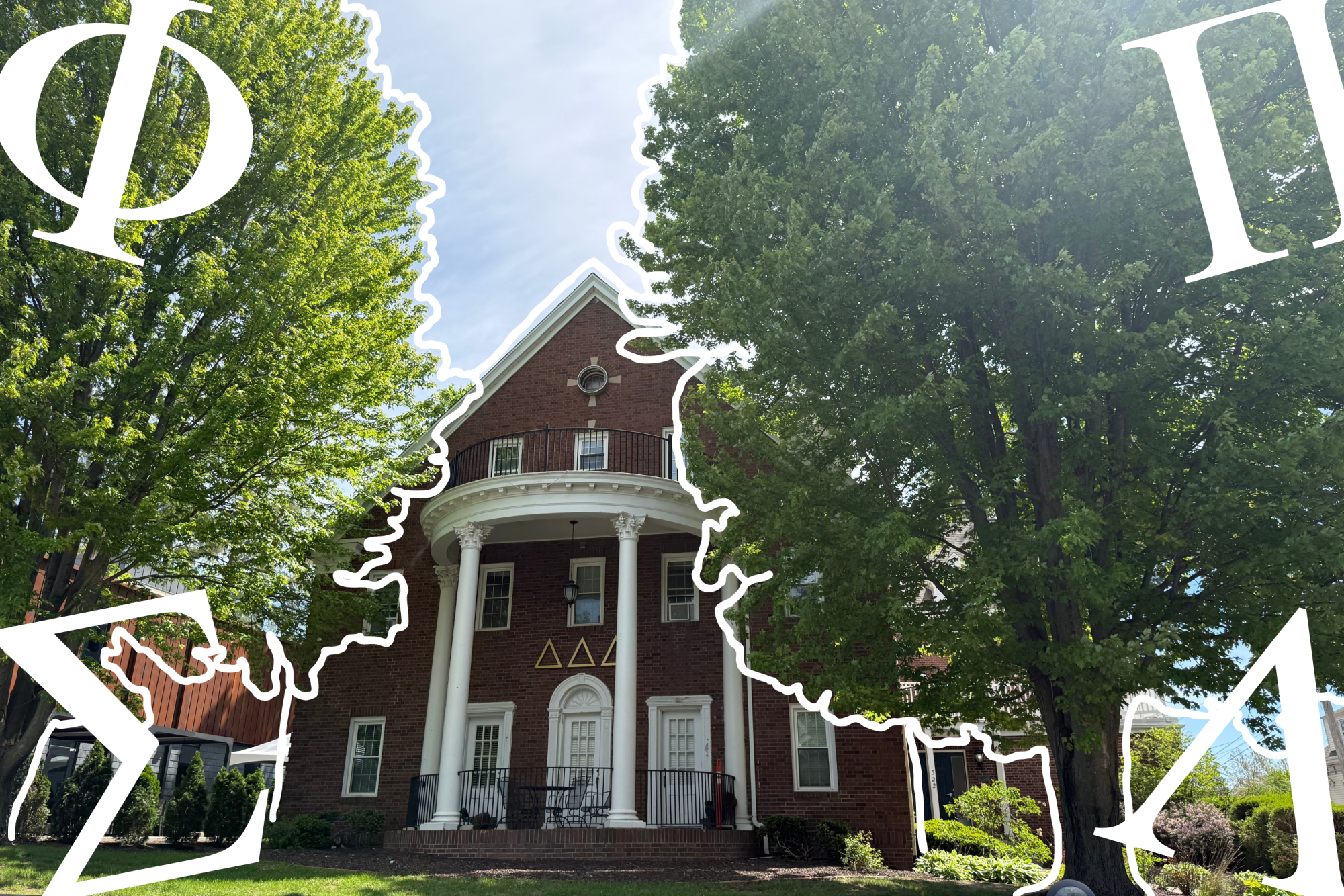
In 2024, the Alpha Delta Phi fraternity at the University of Iowa was placed under temporary suspension after a hazing incident that November. What appeared as a false fire alarm call turned into a fraternity frenzy when an Iowa City police officer found a group of blindfolded, shirtless pledgers lined up in a dark basement covered in unknown substances. For parents, the idea of sorority and fraternity rush week at the University of Iowa may immediately raise eyebrows after viewing the viral video. However, for an 18-year-old freshman interested in rushing, a different image often comes to mind.
Deciding whether to rush a sorority or fraternity is one of the first decisions students make upon setting foot on campus, as Greek life is often seen as essential to “the college experience.” Many students factor in the tight-knit community and traditions, while others consider the long-lasting impacts beyond college, specifically making connections and networking. Although many perspectives on what Greek culture represents exist, Greek life remains significant at the University of Iowa, with over 3,800 active members across over 40 chapters.
In addition to these chapters, four governing councils oversee specific areas: the Interfraternity Council, the Panhellenic Council, the National Pan-Hellenic Council and the Multicultural Council. At UI, board members, directors, governing councils and officers supervise the day-to-day operations and offer guidance for new board members. Chad Warrick serves as the University of Iowa’s director of sorority and fraternity life and leadership. He and his staff work with chapter presidents to address leadership goals and oversee the creation of an environment for personal growth and learning.
“Our staff is responsible for creating an environment that supports the success of our chapters and our students [through] individual coaching,” Warrick said. “We meet with chapter presidents, new member educators and other officers from each chapter monthly. We provide education — designing [the] curriculum around leadership, development and [safety].”
Each house takes away different ideas from these meetings with chapter presidents. Sayler Ribich, president of sorority Alpha Phi, describes her house’s values during the recruitment process.
“Each chapter goes through your [recruitment] video, and [we ask], ‘Do they carry the values that we like the most?’ In Alpha Phi, our values are character, integrity, innovation, generosity and sisterhood,” Ribich said.
Along with educating and helping chapter leaders, Warrick also guides topics to address. The Hawkeye Excellence and Goal Achievement Program is an accreditation program for fraternities and sororities on campus, offering opportunities for planning events, tracking progress and sustaining a social community. The program also facilitates the success of chapters and recognizes yearly achievements.
Warrick emphasizes the importance of helping fraternities and sororities develop strong leadership skills.
“Part of the experience is learning to be better leaders. Our students are developing those skills, whether through communication, teamwork, managing conflict or having difficult conversations with individuals. We’re talking through their personal growth journey,” Warrick said.
While there have been recent national concerns about the safety of Greek life, the University of Iowa upholds a strict policy regarding hazing and underage drinking, with Fraternity and Sorority staff guiding chapters when it is broken. Warrick breaks down the measures taken both within the university and the chapters when misconduct occurs.
“There are many levels of accountability. If a chapter breaks a university policy, a report is sent to our office of student accountability. From there, the office typically will work with its international or national organization. It’s a joint venture between both the national organization and the university to address the allegation,” Warrick said. “If a chapter breaks a council policy, they participate in a peer-to-peer judicial process. Internally, our chapters have their own standards, so if a member breaks a policy, the chapters hold individuals accountable.”
Along with measures addressing policy violations, Ribich believes that Greek life also assists members struggling with mental health and school work.
“At Alpha Phi, there’s a girl [who] oversees health, wellness and accountability. It’s stuff like bad grades, not going to class [and] if someone is mentally unstable. If it’s risky, then it’s more of a redirection; we try to help by giving them certain things to do,” Ribich said. “We have a lot of girls who lean on each other, and there’s likely someone going through the same thing.”
While hazing is the most controversial aspect of Greek life, student-led movements have risen in universities across the country, such as “Abolish Greek Life,” bringing to light other issues. Gaining popularity in 2020, the Abolish Greek Life movement is a student-led campaign aimed at eliminating exclusivity, racism and elitism in fraternities and sororities.
While chapters at the University of Iowa have faced severe repercussions for policy violations, incidents such as the viral hazing video sparked outrage and shock online. Despite potential consequences, Warrick calls out misconceptions people have about sororities and fraternities.
“[Others’] perceptions are based on movies and the Hollywood version of what this experience looks like, and not the actual version of fraternity and sorority life on campus. We combat that by telling our story instead of allowing other folks to tell our story for us,” Warrick said.
For some students, Greek life creates an exclusive atmosphere due to the desire for acceptance, culminating in peer pressure and drama. As a second-year Greek life student, Ribich compares her experience in a sorority to media portrayals.
“We don’t just have slumber parties all the time. In the movies, there’s so much drama; there are so many cliques,” Ribich said. “I live with 47 other girls, and there’s not a single day when I’m like, ‘This is the worst thing ever.’ There’s not a single girl in my sorority I would not hang out with.”
Alongside social Greek life, the University of Iowa offers students various business and law co-ed fraternities. West High alumnus Jack Twait ’25 shares his experience in a business fraternity as a freshman at the University of Iowa Tippie College of Business.
“It’s a great way to meet people, especially if you’re going into a certain career. They have professional fraternities [for] anything from law to Health and Sciences to what I’m in — business. It’s a wonderful way to meet people older than you who can help you find different opportunities,” Twait said.
Recently elected as a brotherhood chair, a position that helps organize various social events throughout the semester, Twait describes the pledging process at Alpha Kappa Psi, a co-ed fraternity available to all business majors at the University of Iowa.
“It was making sure that the pledge class was well adapted and understood proper etiquette. We did interview training, resume workshops and things that could help you stand out and be the best version of yourself,” Twait said. “Alongside that, you do interviews with people within the fraternity so you can get to know active members [and] get advice from them. At the end, you’ll do a presentation on everything you learned.”
Unlike social fraternities, Twait notes that business fraternities at the University of Iowa provide a unique opportunity for those not interested in partying.
“The word ‘fraternity’ is typically associated with just the male gender, but business fraternities and professional fraternities are co-ed, so anyone can join, no matter what gender you are,” Twait said. “It’s not necessarily a party fraternity. We don’t have a house [because] it’s more professional development and networking.”
However, business fraternities do share some similarities with standard fraternities and sororities. Twait explains the shared sense of mutual support within each chapter, whether in school or at social events.
“It puts me around people who helped me strive to be the best version of myself academically and professionally, whether that be encouraging me to stay up to date on my classes, or it’s more socially encouraging me to join things and giving me advice on what to get involved with,” Twait said.
These networking opportunities extend beyond the social sphere, as they contribute to the 97% of Tippie College of Business undergraduate students placed in jobs and graduate programs directly after graduation.
“We have a big alumni base all over the country. It’s a great way to network with people who have gone through internships,” Twait said. “The alumni and current members set you up with connections with recruiters.”
Twait believes that he connected with many friends by joining a business fraternity.
“Being a local to the area, it was hard to branch out when you’re constantly surrounded by people you already know,” Twait said. “I think joining [a fraternity] has helped me meet my best friends.”


