
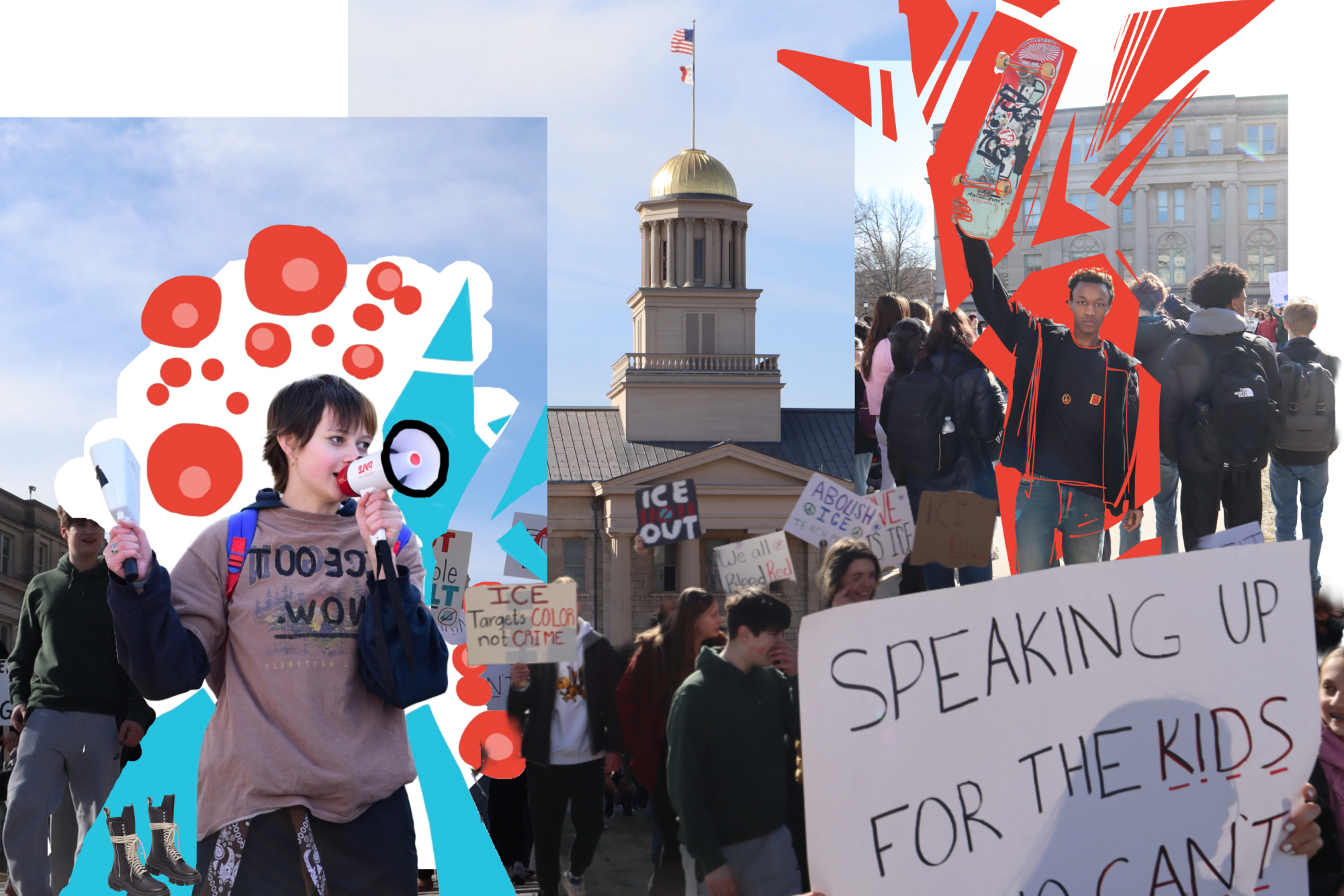



With megaphones in one hand and smartphones in another, Iowa City’s student activists crowd the streets while scrolling through the very news that brought them there — consuming breaking news as they become part of it.
Although the immediacy and digitalization of protesting feels distinctly modern, the spirit of student activism has long been embedded in Iowa City’s cultural identity. During the Vietnam War, students organized mass demonstrations on the Iowa City Pentacrest, joining a nationwide wave of campus resistance to the United States military involvement abroad. In the decades that followed, students continued to mobilize around major political moments, ranging from the Iraq War in the early 2000s to police violence and racial injustice under the “Black Lives Matter” movement.
One of Iowa’s defining student-led efforts was Tinker v. Des Moines, a landmark First Amendment Supreme Court case. Spearheaded by Mary Beth Tinker in 1965, a group of students planned to wear black armbands at school as a silent protest against the Vietnam War. Tinker recalls the events that had built up to the protest.
“By the time I was 13, about 1,000 U.S. soldiers had been killed [in the Vietnam War]. Robert Kennedy called for a Christmas truce to allow diplomacy and dialogue. A bunch of us kids decided to wear black armbands to school to mourn the dead — both Vietnamese people and U.S. soldiers — and to support the idea of a truce,” Tinker said.
Despite its productive intent, Tinker found that her actions led to administrative repercussions: an indefinite suspension. At only 13 years of age, Tinker recalls the fear she felt in renouncing her beliefs.
“We weren’t going to hurt anybody; it was just a small black cloth to show we were grieving. I shouldn’t have been suspended in the first place,” Tinker said. “I was very scared — the shyest person you could imagine — but my emotions were so strong. You can be scared and still take a stand. You don’t have to be brave. Use whatever amount of courage you have, and you’d be amazed what can happen.”
Fueled by that courage, the Tinkers appealed the case, bringing it to the Supreme Court. In a 7-2 decision, the court ruled that students do not “shed their constitutional rights to freedom of speech or expression at the schoolhouse gate,” cementing students’ rights to free speech in public schools. This ruling still stands, emancipating student expression across the nation.
Present-day Iowan students have witnessed a resurgence of anti-war movements across the state with the installation of the second Trump administration. Assembling around gun violence, climate change and the Immigration and Customs Enforcement, students have directed accountability toward policymakers and institutions that impact youth. West High student Alice Gooblar-Perovic ’27 is an avid student activist who engages in protests and formed a West club dedicated to spreading awareness about book bans, after an Iowa law restricted what books a school library can carry.
“I first heard about book-banning in Iowa two years ago. There was a new law that was taking a lot of books out of public school libraries, and I was like, ‘This is crazy. Are we going to do something about it?’” Gooblar-Perovic said. “It felt so out of my control. As a student, you don’t get to vote about these decisions, and it often feels like you don’t have that much of a voice, [even though] it’s directly affecting you and people around you.”
Iowa SF-496 was passed by the state legislature and signed into law May 26, 2023. The education bill mandates the removal of books in school libraries depicting sex acts and prohibits instruction on sexual orientation or gender identity in kindergarten through sixth grade. In response to its initial provisions, Gooblar-Perovic co-founded the Iowa City Banned Book Club in 2023 as both a forum for discussion and student-led activism. Although the club first met informally to comply with the administration, it was formalized in 2024.
“When we started our book club, it was a real uphill battle. The law was still in place, so we couldn’t get a teacher sponsor because that would [enable] banned book distribution in schools,” Gooblar-Perovic said. “We would think we were able to do it, and then we’d get an email from the administration saying, ‘No, let’s wait on that.’ We were an unofficial club, [meeting] in the commons or library. It wasn’t great, but it allowed us to talk about the [books] and do things within the realm of possibility.”
In addition to Gooblar-Perovic’s efforts with the Banned Book Club, she has marched in “No Kings” and “Hands Off!” protests; these Iowa City protests were directed under a coalition of organizations as a part of the greater national movement. Gooblar-Perovic explains how her passion for educating herself and others by reading banned books evolved into further discontent with the Trump administration.
“I feel very strongly about a lot of different topics. There’s a lot of censorship happening with the current administration, which is why I often find myself focusing on books and reading,” Gooblar-Perovic said. “We like to think of ourselves as a democratic country, but there are a lot of things happening that shouldn’t be able to happen in a democracy; basic rights are not being respected.”
Similarly, student activist Thora Schimmel ’28 engages in protests due to dissatisfaction with the current political climate. A second-generation immigrant at West, Schimmel finds that her family’s immigration status shapes her opposition to ICE.
“My mom’s a green card holder and immigrant; I’m a second-generation immigrant, so the political state of the U.S. really scares me right now. I want to do everything I can in my power as a citizen to support those that need help,” Schimmel said. “The ICE raids have started up, [and] the injustice happening in our society shouldn’t [be] something that kids just sit back and watch. Just because you’re not an adult doesn’t mean you can’t speak up.”
In 2026 alone, thousands of Iowans have marched in protest of ICE as a part of “Abolish ICE,” a national grassroots campaign. Gooblar-Perovic believes that protesting is one of the most powerful forms of activism that students can engage in, due to its unifying nature.
“Showing up in person can be a good first step to doing something that could [enact] change. The more people there are, the more powerful it is. You’re immediately taken more seriously, especially as students,” Gooblar-Perovic said.
Recently, students protested ICE through a student-organized “Melt ICE!” walkout Feb. 5. Organized by Tirza Overholt ’26 and Moss Stutsman ’27, hundreds of middle and high school students across the Iowa City Community School District convened at the Iowa City Pentacrest, returning to the very location where Iowa City’s historic Vietnam War protests were once held. Whether through chants, marches or speeches, Overholt notes the importance of providing a platform for marginalized voices.
“It’s not about me. It should be about the people who speak up at the protests and [those who] talk about their families getting taken away. I just want to create a space for that by using the influence that I have,” Overholt said.
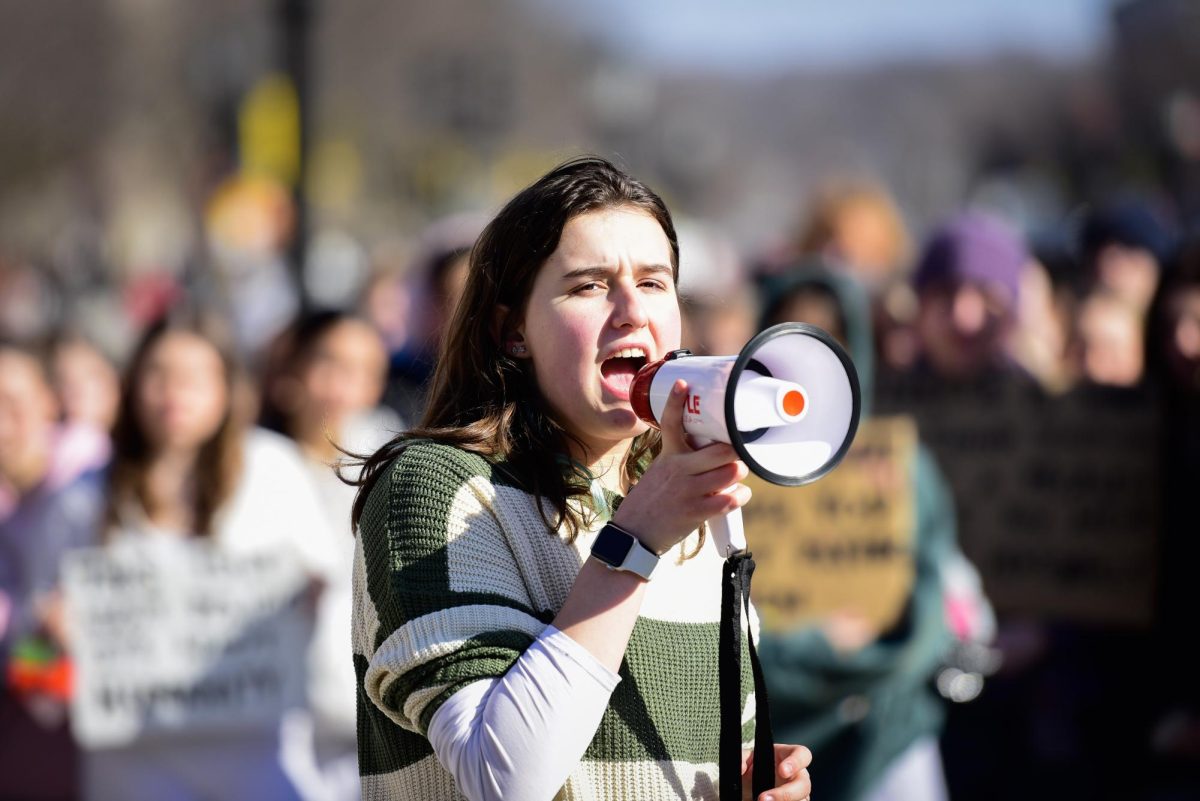
Whether through Instagram reposts or short-form content, social media serves as another prominent platform for both activism and education. According to a WSS survey of 41 students, 73.2% of West students engage in online activism to some extent. Despite its accessibility, many students question the authenticity and effectiveness of this digital engagement. First running rampant during the COVID-19 pandemic, performative activism is designed to enhance one’s social outlook, rather than showing genuine concern for a societal issue. Schimmel, who often posts political messages, cites the benefits and drawbacks of digital activism.
“People looking at [my] posts understand that I’m a safe person to go to in case they find themselves in trouble. It’s to convince people that are in the middle to start caring and start speaking up about what they think is right,” Schimmel said. “[Digital activism] can be a lot of virtue signaling. People forget about what’s happening and will post about all these protests, but then they won’t go to any of them. It’s festering in anger and not action.”
Still, Tinker believes that activism proves effective on multiple scales. Whether digital or in-person, she emphasizes that even small acts of involvement matter — a lesson she believes history has already demonstrated. Pointing to the lasting consequences of the Vietnam War, she argues that deferred governmental action led to years of preventable devastation.
“If [the government] had listened, they could have saved 10 years of warfare. The war didn’t end until 1975. Three to four million Vietnamese were killed. 58,000 U.S. soldiers were killed,” Tinker said. “This is the price of not listening to kids, who usually want peace.”
Ultimately, Overholt urges students to speak up for humanity by becoming involved in protests, legislative inquiry and online awareness.
“Show up to protests, call your legislators and do the things that seem hard, because they’re not really that hard. It’s not as scary as you think,” Overholt said. “Now is not the time to lay back and wallow. [It’s] time to get up and make change.”


