

























The Iowa City Community School District Board of Directors had a long agenda for its meeting Tuesday evening. Among discussions of renovation plans and company agreements, the directors revisited the district’s policies on personal devices and Immigration and Customs Enforcement.
Last year, the ICCSD rolled out a new personal device policy after students came back from winter break. The new policy banned phones and personal listening devices during instructional time. At the beginning of this school year, the district went further to ban all personal devices during instructional time, only allowing school-issued devices during that time. Nearing a year under the new policy, board members started to discuss moving to a stricter ban during the board meeting Dec. 9, 2025.
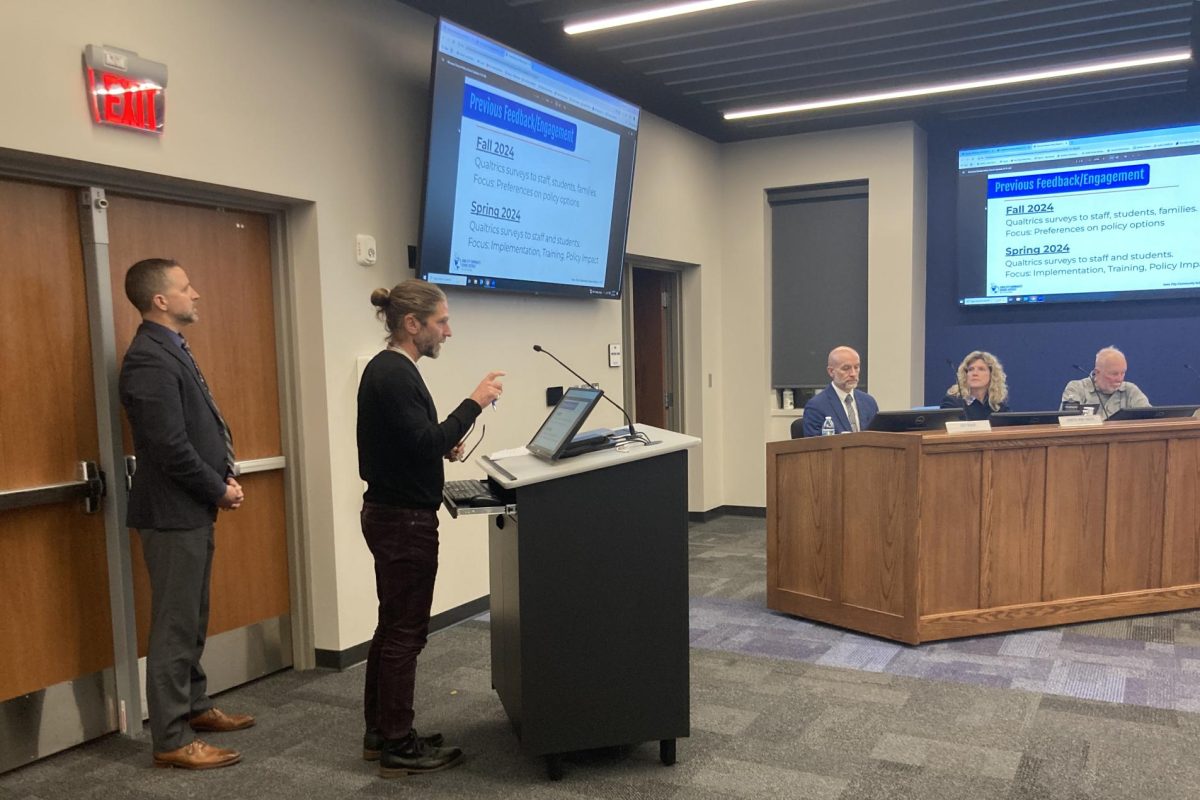
On Jan. 13, the representative for the Iowa City Education Association, Brady Shutt, and the Executive Director of Secondary Schools, Lucas Ptacek, delivered a presentation detailing the development of the current phone policy and a potential timeline for a new phone policy. The potential timeline included polling through March, with the unveiling of a new policy in April for implementation in August at the start of the new school year. The presentation concluded with Ptacek answering questions from the board and facilitating a discussion on what could be changed with a new device policy.
Vice President Molly Abraham opened the discussion with questions surrounding the opinion of high school teachers and administrators on the current policy. Her concerns were based on early teacher polling, including how 75% of West teachers perferring the current policy.
“I’m very interested in looking at high school,” Abraham said. “How do staff feel about the current policy and what it has done to reduce distraction? Has the current policy helped? I want to ask them again now, because we’ve had it for a while.”
Agreeing with Abraham, board member Jayne Finch commented on potentially wanting to differentiate the policy between middle and high school. During her response, she brought up “The Anxious Generation,” a book the board read when creating their first phone policy. The book recommended waiting until high school to give children access to phones, an approach that Finch wants to consider when constructing a new policy.
“I also would like us to not look at a one-size-fits-all approach, because our sixth graders are a lot different than our seniors, and there are a lot of developmental differences between those two age groups,” Finch said. “To add on to Vice President Abraham, I would like some feedback from our middle school administrators and educators. I’m not necessarily certain that we want to do the same approach with our middle schoolers and high schoolers.”
Board member Jennifer Horn-Frasier brought up her concerns surrounding the role of technology in schools. She feels that the school board needs to be prepared to continue having discussions as technology develops and students find ways around rules.
“We have been receiving community feedback related to not just cell phone policy, but just device use in general,” Horn-Frasier said. “I think that it might be an inefficient and maybe even frustrating process to go after one piece at a time if we aren’t looking at the big picture, the outcome we want for all this. We want to maximize academic achievement, we want to maximize student engagement and connection in real life, and technology keeps changing.”
Watch the Board’s discussion of the phone policy starting at 1:06 and ICE protocol at 1:35.After discussing the potential phone policy changes, the board revisited its policy on potential ICE officers requesting entry to district buildings. For the last year, violence from ICE has consistently made headlines. Most recently, the death of Renee Nicole Good prompted protests around the country, including in Iowa City. Good was shot by an officer in Minneapolis Jan. 7 while she was in her car. Statements from the Trump Administration and other Republican lawmakers said that Good was being aggressive and that the action was in self-defense. Footage shows that she was trying to drive away at the time she was shot.
This is in large part due to the election of President Donald Trump. Since his inauguration, Donald Trump has been cracking down on immigration. 2025 was ICE’s deadliest year in two decades and was responsible for 32 deaths in its custody, according to The Guardian.
Chase Ramey, the district’s deputy superintendent, started the conversation with an overview of the current protocol for law enforcement visits.
Key points of the policy include that staff members should not open doors for officers and instead contact the school principal, who would then inform the district offices of the event. All officers entering the building require proper identification, a legal reason for entering — a warrant, subpoena or other equivalent — and would be accompanied by the principal while on the premises. In response to a question by board member Abraham, Ramey stressed that this policy is not new and works the same as their policy for potential police officers.
“That’s actually been our practice, Director Abraham, is that we do ask for documentation that shows why they need to be there,” Ramey said. “We’ve developed good relationships, so we’re able to have those conversations with law enforcement, as we work through some of those pieces. I just bring that up to reiterate that it’s not new, that it’s not something that has not been on the radar of our administrators.”
Additionally, this policy is specifically designed to avoid placing teachers or other staff members in confrontation with any law enforcement officers who visit the school. While the board considered issuing a resolution on ICE’s activities, it ended up completing the discussion with a note to remind front office staff of the safety regulations surrounding potential officers at school.