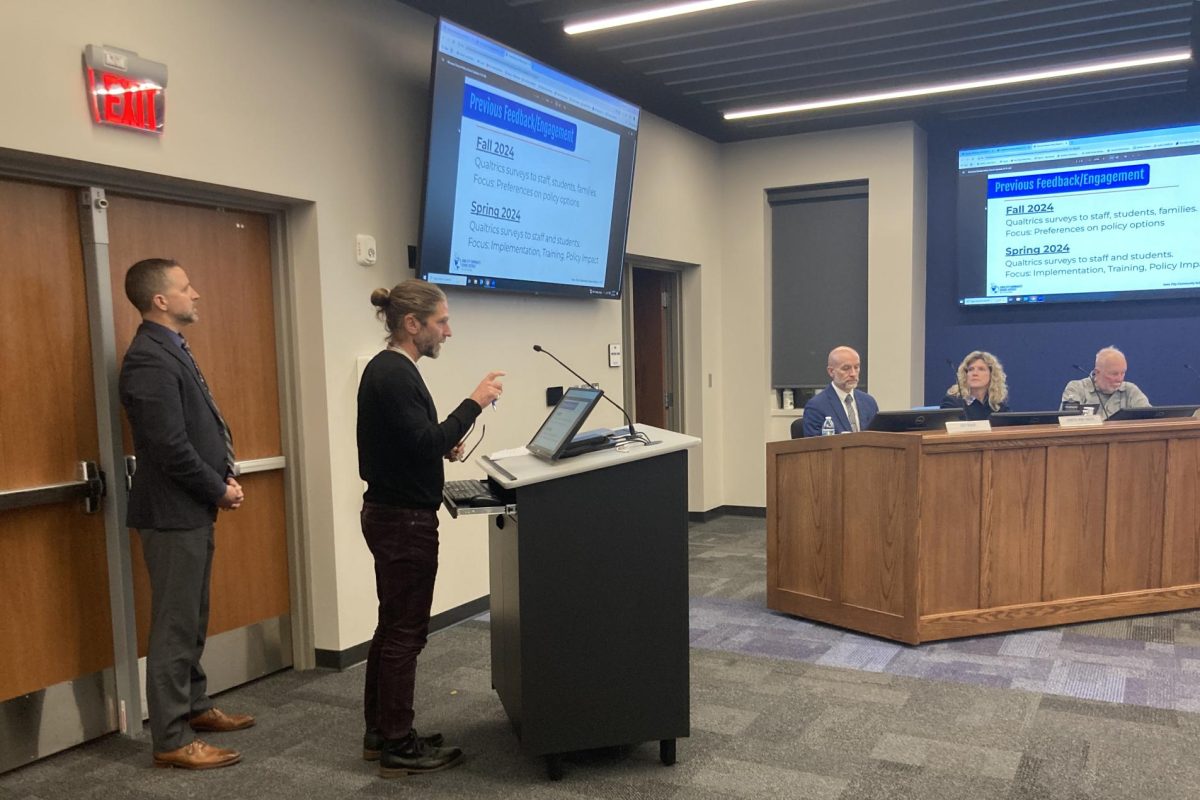
























Representatives from Junior Achievement first spoke to the Iowa City Community School District about the possibility of opening a new educational facility, named the Dream Accelerator, in the basement of the district’s new Center for Innovation on Oct. 22, 2024. They pitched the program as an interactive way for students to experience potential career paths. Later that week, Board Members Jayne Finch and Lisa Williams traveled to the single existing location in Greenwood Village, Colorado, where they saw students experiencing the program.
After traveling to the existing location, Finch and Williams disagreed on whether the district should pursue the project. At the Nov. 12, 2024, meeting, Finch was critical of the project due to its simplicity and continued reliance on screens.
“I still have doubts. I’m just not sure this is the type of hands-on things that we were looking for. I felt it was kind of surface-level,” Finch said. “I think some of this technology could be obsolete in a few years, and it [could also] be accomplished in a classroom with a Chromebook.”
During this same meeting, Williams saw the benefits that the project could provide, including the lessons and courses outside of the physical Dream Accelerator.
“I enjoyed it a lot, and I really think that our students would probably benefit a lot from having that program here. I think it would be something exciting for them to experience,” Williams said. “It’s not just one thing you do, like your junior year of high school, and you just go once and that’s it. It’s really a program that would build progressively as [students] come through the district, and the skills build upon each other.”
Junior Achievement returned Nov. 12, when they received a letter of intent to develop the Dream Accelerator in a 5-2 vote. After the vote, Nate Klein, the vice president for education at Junior Achievement of Eastern Iowa, started designing what the facility will look like at the Center for Innovation.
“By the school board signing the letter of intent, they basically said to us, ‘start the process’. As bills come in, [the school board] is intending to pay them, so there isn’t a vote that has to happen every single time a new bill comes in. Our understanding is that they’ve greenlit the project,” Klein said.
The Dream Accelerator is planned as part of a larger curriculum designed to help students find possible career paths.
“I think it’s important to know that the Dream Accelerator is not going to be just this one experience. It’s going to be a part of a larger listening opportunity for students to explore careers and their options, which will culminate in this Dream Accelerator experience, or their dream day, and then have a capstone experience of them being able to validate some of those learnings through a credential,” Klein said.
While the estimated cost of the project is over $2 million, the project has only awarded contracts for its first phase. On Sept. 18, seven packages totaling $536,630 were awarded for general construction, drywall and ceiling installation, floor finishing, painting and coating, fire suppression, heating and cooling and electrical wiring. Klein stresses that the funds for the new building are all coming from the district’s Physical Plant and Equipment Levy as opposed to the general fund, used for staffing and smaller equipment.
“Schools have different buckets of funding, and [the funding for the Dream Accelerator] is not necessarily coming out of the one that supports faculty or staff,” Klein said. “[The funding] focuses just on the capital improvements for the district. When you think of music programs or athletics or a new science facility, whatever that might be, that all comes from this fund that they have built up over time to make improvements for the district.”
The district is planning to launch the program through the 2025-26 school year, with the facility possibly opening in the spring of 2026. While the main appeal of the program is the physical location, Klein also notes the importance of the curriculum.
“The goal is to have a soft launch in the late fall, and then have students walk through their dream day after January first,” Klein said. “The dream accelerator is going to be more than just a one-time coolest field trip ever. It is going to start with [a] curriculum this fall that really dives into career success and letting students experience what some of those career and work readiness opportunities look like.”