



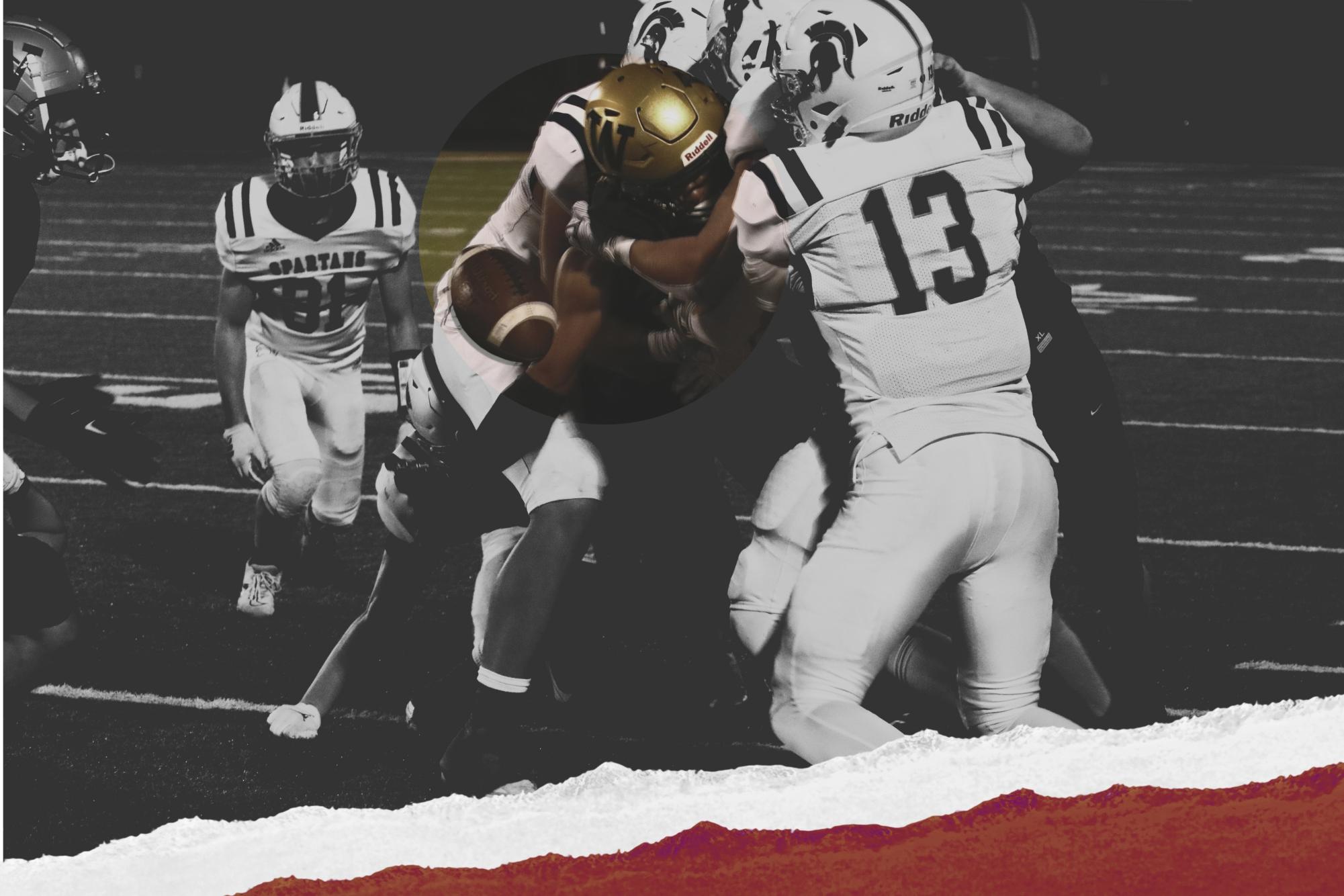
As West High wide receiver Carter Spark ’27 stepped onto the sideline, adrenaline still surging, he passed out. The glaring stadium lights and roaring crowd only grew more overwhelming as he tried to grasp what had happened. Just moments ago, he’d been running a route on the football field; the next, his vision was spotty, his ears ringing and his head pounding. A significant impact had led to a serious concussion, and his entire season was nearly cut short.
Along with approximately 100,000 high school football players from 2024-25, Spark was diagnosed with a concussion. A concussion is a mild traumatic brain injury that occurs when the brain moves or twists inside the skull, usually after a blow to the head or sudden acceleration.
“I got tackled by three guys, and my head hit the ground,” Spark said. “Then, the guy fell on top of me, so I made contact with the ground and got another helmet-to-helmet contact after the play. Right away, I got up and didn’t think anything of it. I started jogging to get to the next play, and I started to get dizzy. I tapped my helmet, went to the sideline and collapsed.”
Symptoms affecting cognition and causing confusion may be subtle and not occur right away, but others — such as dizziness and sensitivity to light or noise — often appear immediately. According to Dr. Jeremy Greenlee, a professor of neurosurgery at the University of Iowa, concussions produce a wide range of symptoms.
“These symptoms can be seen in isolation or in various combinations across people after a concussion,” Greenlee said. “Generally, [people with] concussions completely recover, but in some cases, permanent effects can be seen.”
Despite these effects, a majority of athletes gradually recover from concussions in around 7–10 days. However, West Assistant Football Coach Tyler Meade expresses that every case is different, and it can be difficult to get an athlete back onto the field because of the brain injury’s unpredictability.
“The biggest differences you see are the variety of times it takes to return,” Meade said. “Some are feeling fine the next day, and some are having headaches for weeks. That’s always the tough part — concussions aren’t like a broken bone. You’re totally going off of how [the athletes] feel.”
With a volatile recovery process, Greenlee notes how crucial it is to proceed with caution.
“[Recovery time] can vary a lot; sometimes hours, but sometimes weeks,” Greenlee said. “Only after all symptoms have resolved, [start] non-contact practice and drills to make sure that exertion does not cause any symptomatic recurrence. You can’t ‘shake off’ a concussion — it’s a mild traumatic brain injury.”
To navigate the unpredictable recovery process, West athletic trainers assist athletes with a deliberate plan of rest and assessments. Throughout Spark’s recovery process, trainers monitored his symptoms as he moved from resting to full practice.
“For about a week, I did no physical activity [and] just let myself heal,” Spark said. “Once I felt good, we went through a test on the Sway app. It’s to see if you still have symptoms. I passed, and then I went right into [active] recovery. The trainers here at West are amazing, and they’ll help you get through that recovery process quickly.”
The Sway Medical app, used by West trainers, is Food and Drug Administration-cleared and helps manage and assess concussions by testing static balance, reaction time and cognition. Its mobile design allows athletes to be tested anywhere, streamlining recovery decisions.
In addition to the Sway Medical app, Greenlee notes that similar innovations are revolutionizing concussion management.
“There is a lot of research happening now on concussions,” Greenlee said. “New tests are being developed to rapidly diagnose concussions via saliva, blood or eye tests. Additional tests are being developed for monitoring symptoms after concussion to guide return to play decisions and better predict recovery timelines.”
Despite improving research and innovation, concussions carry a stigma — often discouraging athletes or parents from participating in sports.
“Head injuries have become more of a hot-button issue over the years,” Meade said. “Sometimes we’ll hear about kids who don’t want to play, or more often, their parents are nervous about them playing. At the end of the day, it’s their decision, but [we] at least want to explain that a lot has changed to make [playing football] safer.”
Greenlee agrees that while concussions can’t be eliminated from sports, education is the most effective method of prevention.
“We’ll never be able to eliminate all concussions, but athlete, coach and parent education, improved helmet technology, proper technique and rules to minimize head impact are all helpful,” Greenlee said.
Like Greenlee noted, another innovation that has transformed the playing field is helmet technology. According to a Virginia Tech Helmet Lab study, the new Guardian Cap XT — the version currently recommended for youth athletes — reduces concussion risk by 15% when one player wears it and by 22% when both do. Additionally, athletes are taught new tackling techniques, where they don’t use their heads to tackle, but the rest of their bodies.
“The helmet companies all get rated pretty regularly, and [they’re] always testing and improving their technology,” Meade said. “The helmets [West] buys are on the higher end, as far as quality of safety. Within the past 10 years, the technique of blocking and tackling has completely changed. Years ago, you would put your helmet in the way of where the ball carrier was going, and that’s completely flipped; now, you’re fitting your head where it’s safer.”
Although technology and research have improved dramatically, Greenlee explains that concussions are still dangerous — especially at a young age.
“All concussions are worrisome, and efforts should be made to avoid them — especially for young [kids], where the brain is still developing and maturing. Younger patients may show more mood changes than older patients after a concussion,” Greenlee said. “The most dangerous thing about concussions is ‘second impact syndrome’ which can be fatal due to rapid brain swelling and happens with repetitive brain injuries in close succession.”
Contrary to Greenlee, Meade believes kids should participate in sports at a young age to learn to protect themselves.
“The big question is, what age should kids start playing football, or should they be playing flag football instead until a certain point?” Meade said. “The key at that age is — even though they’re playing tackle [football] and adding that risk — kids are so much smaller and slower, that’s the time where you can teach proper technique so that as they get older and get bigger, they’ve learned those good habits.”
After experiencing a concussion, Spark is more perceptive of the risks of concussions, but also the progress being made in medical treatments.
“[Getting a concussion] made me more cognizant. This could affect me for the rest of my life, ” Spark said. “[However,] I love sports, and they’re a big part of my life, so it’s worth the risk.”
For athletes like Spark, every stride forward in the field of concussion research brings additional confidence to play safely.
“We know a huge amount more now about concussions than 10 years ago, thanks to public awareness and research efforts,” Greenlee said. “It’s only going to get better as research pays off, and we can diagnose and treat concussions more quickly and effectively.”


