




































At the Google I/O event in Mountain View, California May 19, Google announced many new artificial intelligence features to their products, most notably an AI-first Google Search and video generation models integrated into YouTube. Both of these new features directly go against what their core products actually do, and in my opinion the shift is a profoundly short-sighted move.
Google Search makes its money by showing ads in the search results and websites using Google Ads, but the AI overviews are already decimating ad revenue for websites because users tend to only read the AI summary and not click on websites or ads, leading to a 58% drop in click-through rate. Google claims that their own ad revenue isn’t down because of ad spots in and around the AI overviews, but the websites that the AI overviews cite information from do not benefit from this.
This significant drop in ad revenue is causing websites already constrained by ad revenue to shut down or lock content that used to be free with ads behind paywalls, such as hardware testing and review lab RTINGS.com.
The shutdowns or paywalling of websites that offer high-quality content harms Google Search’s quality of results, pushing low-quality content higher in search results while the websites that users actually want are buried due to lack of free public content. The AI craze makes pushing low-quality slop content easier too, since large language models are great at generating pages and pages of pure nonsense that only vaguely make sense at a surface level.
Along with the loss in ad revenue of organic search clicks due to AI, there’s the increasing worry around websites being scraped for AI training without consent. AI scraper bots overloading servers with excessive data usage and copyright concerns over content used in AI training have also led many websites, primarily news sites, to attempt to block scraper bots from accessing their content.
Many of these attempts have proved ineffective, with scraper bots bypassing blocks quite easily, primarily through not respecting internet specs that rely on good faith and lying about who they are. Meanwhile, honest scrapers used for legitimate purposes are hit as collateral damage. Of the affected honest scrapers, the Internet Archive’s Wayback Machine is now blocked by many news sites, due to the concern that the Wayback Machine’s archive of sites could be used to train AI, and that allowing the Wayback Machine’s scrapers would be an open invitation for malicious bots to steal the identity of their scrapers. The Wayback Machine is an incredibly useful tool for preserving the history of web content, and these blocks being caused by the AI craze that Google is contributing to is extremely ironic when Google partnered with the Internet Archive to incorporate the Wayback Machine directly in search results.
In spite of everything showing that these AI features are harming their core product of an internet search engine, Google announced at Google I/O that Google Search would go all in on AI, prioritizing AI-generated summaries and answers over traditional search results and expanding the capabilities of AI mode in search to push people towards it and away from traditional search.
Gemini 3.5 Flash, the LLM that powers this new enhanced AI mode, has a quoted end-user price of $1.50/million input tokens and $9.00/million output tokens, where one token is the base building block that a sentence is broken up into for processing. This price is extremely expensive even compared to Google’s other LLMs, and with AI companies operating at profound losses due to the price of running and training models being much higher than what they are charging, the cost in the back end to run Gemini 3.5 Flash has to be even more expensive, compared to the miniscule amount of cost that a traditional Google search costs in terms of operating expenses. One has to wonder, what’s their plan here? Use an extremely expensive top tier model to provide a service for free that actively cannibalizes their main product?
Within just a couple of days of this AI-first search algorithm, core features of Google Search broke. For example, previously, when a user searched a single word as their query, the overview would be a dictionary definition pulled from Merriam-Webster or Dictionary.com. Now, it shows an AI-generated definition, which does not have any tuning in place to make it reliable or correct. Many users have reported that words like “disregard,” “ignore,” or “cancel” causes the AI overview to treat that as a request instead of a word to define.
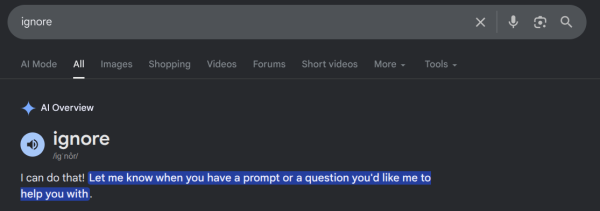
Granted, they seem to have fixed this as of time of writing, but any sort of testing would’ve caught this. Also, why would Google use an LLM for an extremely simple database lookup. Just why.
Google also announced that Gemini Omni, their new video generation model, would be directly integrated into YouTube Shorts, allowing for users to edit a short directly within the app to change the looks or content of a short. This is, to put it mildly, a god-awful idea, and I have absolutely no clue how it made it past the conception stage and entered into production.
Transforming images and videos using generative AI has proven to be a magnet for harassment, hate speech, non-consensual pornographic imagery and child sexual abuse material, such as with X’s (formerly known as Twitter) Grok image generation and various AI image generation apps. AI image generation has a track record of trivializing the making of such content, so I have no idea how Google’s legal and public relations teams approved this. And to make it even worse, this functionality is a direct in-app feature just like Grok image editing, making it trivial for anyone with access to make slop videos that run the aforementioned risks.
Generative AI models, as mentioned, run into ethical issues regarding ownership of content, as they tend to require mountains of training data that can only realistically be obtained through mass piracy and intellectual property theft, and creatives such as content creators on YouTube tend to be rather protective about their IP. YouTube has already angered some of their creators with AI features in the channel management systems, such as AI-generated video ideas and unwanted automatic translations with terrible AI voice dubbing, so why alienate them further with the automatic CSAM machine that uses stolen content for training?
But the AI hype money from investors is more valuable than such trivial things as ethics or long-term stability, I suppose.


