


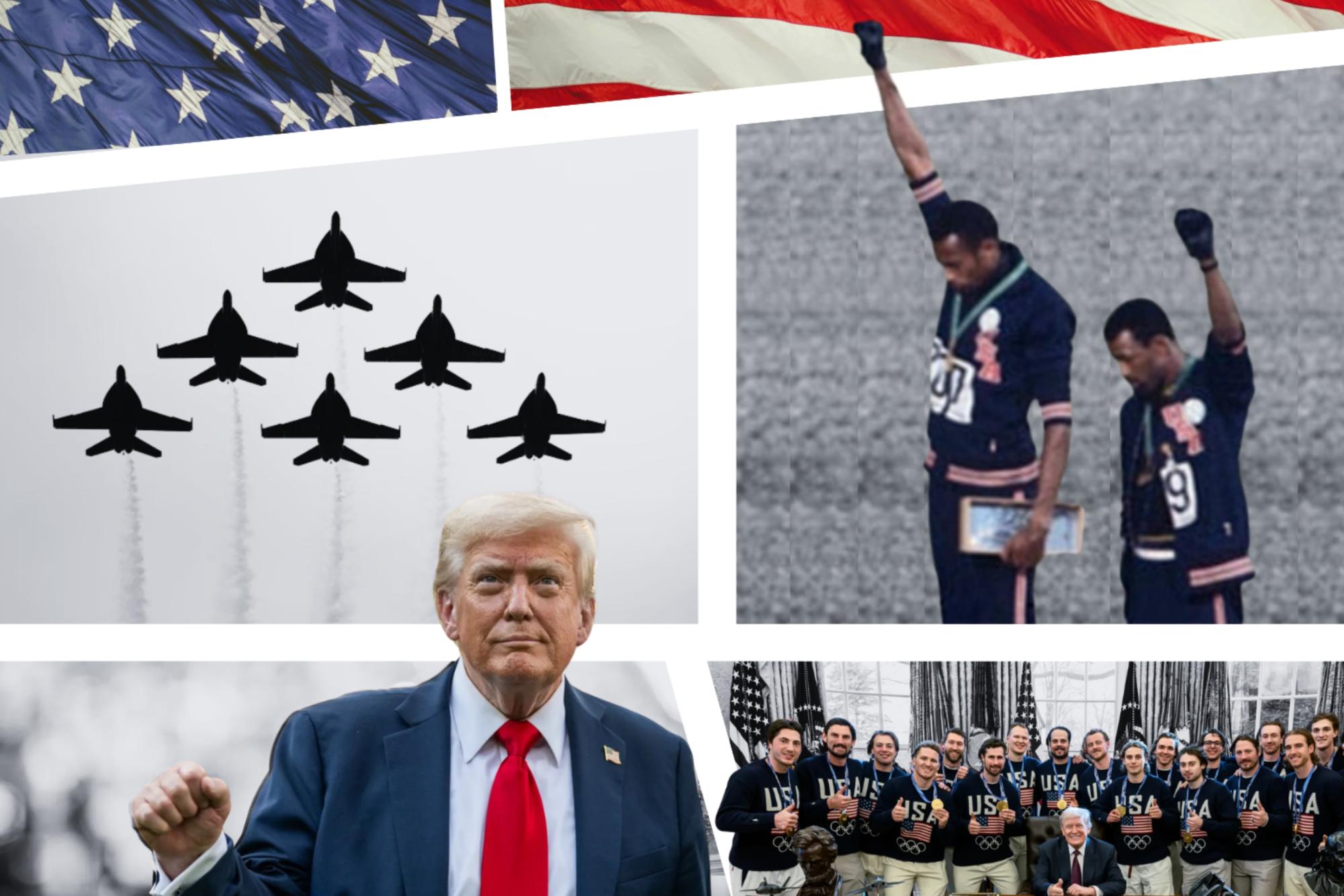
Across the country, millions tune in from home or head to crowded stadiums to watch action-packed, thrilling games. In the United States, sports are among the most popular forms of entertainment. Recent events like March Madness and the 2026 Winter Olympics drew an average of 10.7 million views in the first week and 24.1 million American viewers, respectively. But behind the exhilarating hits and scores, political undercurrents often go unnoticed. Many don’t associate the Olympics with geopolitics, or NFL games with government-funded stadiums. As sports settings attract massive audiences and allow new forms of politics to emerge, subtle patriotic acts can have significant political influence on sports fans.
80% of adults believe the country is divided on key values, with visible, deep divisions continuing to widen the gap between parties on controversial topics like gun control and immigration. As politics becomes more ingrained in the daily lives of Americans — including the sports world — Dr. Thomas Oates, a professor of journalism and American studies at the University of Iowa, works to understand the intersection of sports and popular culture.
“There are plenty of examples of politics woven into everyday sports that are totally unremarkable. For example, playing the national anthem before a game is a political statement about where our loyalty should lie and what we should respect,” Oates said.
When it comes to sporting events, traditions like military flyovers and national anthem performances are often perceived as nonpolitical components of the game. In reality, these events can have broader implications, such as encouraging military enlistment and boosting government support.
Athlete activism influencing public opinion has occurred for several years. In 2016, when NFL quarterback Colin Kaepernick first sat and later kneeled during the national anthem as a peaceful protest against racial inequality, Black oppression and police brutality. This act of civil disobedience sparked nationwide controversy over pillars of American identity. According to the 2024 AP Election Poll, 84 to 91% of Americans agreed on the country’s core values, including freedom of religion and equal protection under the law.
“People still wear T-shirts that say, ‘I stand for the national anthem,’ which is clearly a reference to what Kaepernick decided not to do,” Oates said. “When athletes use sports to draw particular elements of politics and how those politics affect their communities, it gets lots of attention.”
Oates highlights the extent of politics in society, noting that even widely settled upon issues are political. While predisposed worldviews largely influence people’s political ideologies, Oates researches how sports have highlighted political beliefs.
“Just because a lot of people agree with something doesn’t make it nonpolitical. Some of the most powerful political positions are widely held. Those are the most potent ones, and we know these things change over time because, if we study history, we can see a lot of examples,” Oates said.
Historically, sports and politics have been heavily intertwined. During the 1968 Summer Olympics in Mexico City, African American athletes Tommie Smith and John Carlos gave a Black Power salute on the podium during the U.S. national anthem to protest racism and injustice. Although 94% of athletes support activism engagement, this symbolic gesture received immediate backlash around the world, culminating in the duo being banned from the Olympic Village and suspended from Team USA, despite Smith — the gold medalist — setting a new world record for the 200-meter dash that day. Their raised fists symbolized the deep connection between racial discrimination and sports in the United States. While Oates finds that sports have always been connected to politics, he points out that the visible demonstrations of politics in sports have grown in recent years.
“There are deliberate events put on by sports organizations, and they have political meaning to some people, so those things are also pretty normal and regular. Certain kinds of political expression have become more common in my lifetime,” Oates said.
Gwen Smith, a senior at West High, closely follows politics and sports. Smith echoes Oates’ belief that the popularity of sports drives political discussion, crediting former Iowa Hawkeyes basketball player Caitlin Clark with fueling discussion around women’s sports. While Clark, the first pick in the 2024 WNBA draft, has a $28 million, eight-year endorsement deal with Nike, she only earns $530,000 by her third season. However, in the NBA, the first overall pick makes an average of $15 million by his third season. Smith points to the pay gap and disparities in facilities between the WNBA and NBA, but argues that Clark has drawn greater attention to women’s teams. In 2024, all 12 WNBA teams had at least double-digit growth in attendance, led by the Indiana Fevers with a 319% increase.
“Specifically in Iowa City, there are a lot of people who are absolutely intrigued by the phenomenon that Caitlin Clark has brought to women’s sports, and women’s basketball in particular,” Smith said. “That expansion of women’s sports has pushed people to have conversations about the inequities in politics.”
While fans are entitled to their personal values and tend to support athletes based on their politics, Smith believes it is also important to separate an athlete from their political views, noting that stigmas can exist around who participates in sports.
“A lot of people, mostly online, will find reasons to uplift athletes for certain viewpoints. The way that professional athletes interact with their audiences and the things that they say definitely have a big influence on younger fans. [For example], people who go to West might carry those stigmas in sports to the people around them,” Smith said.
Politics not only influences sports at the professional level, but also impacts student athletes in local clubs. Taha Salem ’28 has played soccer for six years at both Northwest Middle School and the Iowa Soccer Club. He describes his experience playing a sport where politics heavily shaped team dynamics.
“I’ve often seen a political divide in how teammates treat each other. When I was on the soccer team, there was a big divide between people’s [political beliefs],” Salem said. “On both sides of the spectrum, politics can shape how different groups are treated.”
As someone who plays a team sport, Salem believes that athletes should be able to freely express their political opinions, while remaining mindful of those with different beliefs.
“You should still express your political opinion, but you shouldn’t do it to a degree that causes conflict within the team, because often that leads to bias,” Salem said.
According to a 2023 poll by The Washington Post and the University of Maryland, 77% of Democrats and 25% of Republicans said athletes should express their views on social and political issues.
Modern debates about whether professional athletes should speak on political issues have emerged among both avid fans and non-fans. When Hunter Hess, an Olympic freestyle skier representing the United States in the 2026 Milano Cortina Games, was asked whether representing the United States meant he supported its immigration policies, Hess explained that he had mixed emotions. A few days later, President Donald Trump posted on Truth Social, calling Hess “a real loser.” Oates notes that, regardless of the influence an individual has, speaking up for one’s beliefs is essential in a democracy.
“Nobody says to private citizens, ‘Oh, you shouldn’t try to influence people’s politics.’ That is not what life in a democratic society is supposed to be about. People are supposed to try to convince their fellow citizens what the right course of action is,” Oates said. “Sometimes they are going to do so in a very aggressive way because they care a lot, which is okay as long as they’re not violating anyone else’s rights or creating dangerous situations.”
While sports events can influence political discussion and often create emotional connections among athletes and fans, Oates believes these collective experiences are often surface-level and can overlook deeper political and social divisions within society.
“Sports is an important place where people try to advance the idea of unity. We are somehow all united, and that is a really powerful idea, but that unity is really superficial,” Oates said. “When people use sports to promote unity, they’re actually imagining something that is very powerful and suffuses all aspects of life, and it’s not very real.”
Oates explains that disagreements and debates are vital for social progress in a democracy, as diverse mindsets can foster new ideas.
“We don’t always want unity in a democratic society; we don’t want people to all think the same way. That only happens in totalitarian societies. Disagreement, dissent, argumentation and scandal are all things that come with the territory of democracy,” Oates said.
Alongside Oates, Smith argues that it is beneficial for professional athletes to speak on issues, as loyal fans can be influenced by their large platform. Specifically, 47% of millennial adults are incentivised to purchase products based on athlete endorsements.
“Professional athletes know they have a large platform, and they can speak out about issues. It’s important that they do, because if they have issues that they care about, they have the ability to speak on them, and people will listen,” Smith said.
Oates believes that professional athletes who speak on contentious topics often receive mixed reactions from the public.
“People don’t like it in part because they don’t agree with the politics, but also, part of them don’t like the idea that there are people who have more influence than other people in this society. But that’s just how society has always worked; that’s not the fault of athletes,” Oates said.
After coming out as pansexual in 2019, U.S. women’s figure skater Amber Glenn received strong support from the LGBTQ+ community, with pride flags following her to every competition. In an interview during the 2026 Winter Olympics, she said the community needed to come together in response to President Trump’s approach toward the community. Despite backlash and what she described as a “scary amount of threats” in response to her statement, Glenn emphasized that she would continue speaking about politics because it affects everyday life.
“I hope I can use my platform and my voice throughout these Games to try and encourage people to stay strong in these hard times,” Glenn said. “A lot of people say, ‘You’re just an athlete — stick to your job, shut up about politics,’ but politics affects us all. It is something that I will not be quiet about.”
Smith echoes Glenn’s perspective that athletes have the right to express their political opinions, and that the public can decide how to respond.
“Athletes are people, and while they are public figures, they’re people with opinions. It’s up to the fans [and] the rest of the world to decide whether or not they want to continue to support an athlete based on their opinions or beliefs, but that doesn’t discredit them as an athlete,” Smith said. “A lot of people forget that public figures are also people. They have opinions, they have things they can share with the rest of the world if they want. It’s their choice, but it’s not a bad thing to choose, and they should be able to do that if they feel an issue is important [to] them.”
Oates agrees, noting that athletes who face scrutiny for speaking out shouldn’t be ostracized from their sport, as they are exercising free speech.
“[Many people] like to think that their worldview is either universally held or the right position to hold, and there aren’t really other positions. A lot of people think that way, but that doesn’t mean that when someone expresses a different opinion from you, that’s the moment when politics enters the conversation,” Oates said. “Politics is always there. The idea that athletes should somehow be excluded from the zone of ordinary citizenship that we expect of everybody else is completely unfair and ridiculous.”
Politics has been ingrained in sports since the very beginning, and Oates indicates that the relationship between sports and politics will only become more visible in the future.
“[Politics] will continue to be there because sports are a part of life. Things that are a part of life get people to talk about their values, and the things that people value are the things that make politics,” Oates said. “There is no place in popular culture and entertainment that is a complete escape from politics. So, a lot of times, people will say they’re watching sports to escape politics, and I would say, ‘No, you’re not.’”
Politics is not only deeply embedded in sports communities but also in other forms of entertainment, playing a key role in shaping belief systems and daily life.
“Maybe you don’t recognize what’s happening, but you are definitely not escaping politics. Politics is always present — not just in sports, but in drama, literature, commercials and all kinds of things we consume every day,” Oates said. “Politics suffuses those things because politics is the [fabric] of society. If you want to reach people, politics is one way, and people are going to use it.”


