


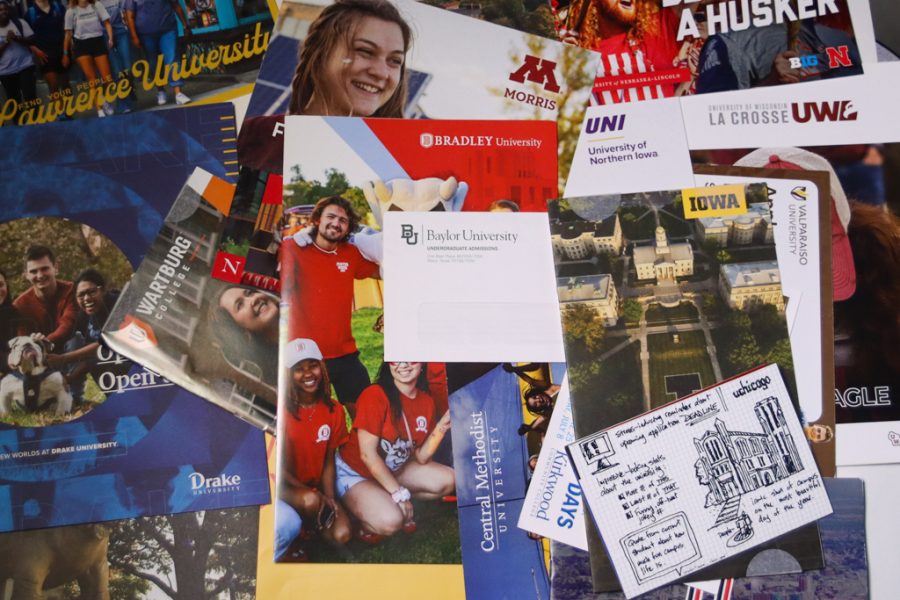
The average public university undergraduate in 2024 owed $31,960 in student loans and took about 20 years to repay them, according to the Education Data Initiative. This substantial debt not only impacts millions of students across the country, but also the future of students at West. Grace Vignato ’26 faces the reality of future student loans and debt when applying to college.
“The career I chose, Equine Training and Business, [makes] $40,000. The only school that offers the curriculum that would work for me is Lake Erie [College]; it’s $41,000 a year,” Vignato said. “With my degree basically costing me [a] yearly salary, I know I’m going to be in a lot of debt, which is scary.”
Vignato’s fear reflects a larger issue for incoming undergraduates: how recent federal policy changes have reshaped federal aid. Although there are seven main federal student aid programs available, the Free Application for Federal Student Aid is the program most used by students. It determines a student’s eligibility for federal student aid, specifically, federal grants, work-study programs and low-interest student loans. However, FAFSA is among several federal programs affected by President Donald Trump’s One Big Beautiful Bill Act, which will cut over $300 billion from federal higher education funding and student loan programs over the next decade.
These cuts affect not only low-income students, but also higher-income applicants. Vignato, a middle-income student, only qualifies for school aid through FAFSA, or financial aid provided by the university. However, she no longer qualifies for federal aid.
“When Biden was in office, I would have qualified for minimal FAFSA, which would have taken off [a] partial burden … but then Trump cut it more significantly, so I no longer qualify for the amount of aid I would have gotten,” Vignato said.
Alongside changes in federal aid, recent changes in college admissions have brought consequences for students beyond U.S. borders. Trump first proposed the Compact for Academic Excellence in Higher Education Oct. 1 to nine universities, which was later offered to all public universities Oct. 14.
In the 2023–2024 school year, there were roughly one million international students in the U.S. Under the Compact, colleges would cap foreign enrollment at 15%, including a maximum of 5% from each country. Gianna Liu ’25, a West graduate and current freshman at Northwestern University, sympathizes with affected international students.
“International kids are honestly fearing for their lives that they’re [going to] be sent back to their home country and never come back again. They’ve worked so hard to get to the school that they wanted to go [to] – just as hard as anyone else, [and] probably even harder,” Liu said.
Additionally, the Compact would also require a tuition freeze — maintaining tuition at the same price rather than increasing it — for five years. While universities have the option to sign the compact, schools that decline to sign would risk losing most or all federal funding for the year. However, with less federal funding, universities face more pressure to help students cover tuition.
As of Nov. 7, over a dozen universities have rejected the Compact, with the Massachusetts Institute of Technology the first to do so. In her letter to U.S. Education Secretary Linda McMahon, MIT President Sally Kornbluth explains that the Compact doesn’t align with MIT’s core values, such as rewarding merit, need-blind admissions and free expression. In Brown University’s Oct. 15 rejection letter, university President Christina Paxson wrote, “I am concerned that the Compact … by its nature and by various provisions would restrict academic freedom and undermine the autonomy of Brown’s governance, critically compromising our ability to fulfill our mission.”
While a few colleges have rejected the compact, universities in Iowa have yet to decide. The Iowa Board of Regents is a group of nine citizens who govern Iowa’s three public universities, including the University of Iowa, through policymaking, coordination, and oversight. The board is currently reviewing the Compact for the University of Iowa, which has led to opposing views between constituents. Iowa House Democrats have written a letter to the board, stating, “We urge the board to reject President Trump’s ‘Compact for Academic Excellence in Higher Education’ so we can maintain our cherished universities.” Meanwhile, state Republican leaders have expressed their aim to sign the Compact, with Republican Senator Lynn Evans writing, “Iowa has a chance to be a leader in higher education reform by having our universities be the first to sign on to this compact.”
Although the Trump administration’s compact has drawn debate, another policy change — the rollback of Biden’s Saving on a Valuable Education plan — impacts loan repayment. Enacted in August 2023 by former President Joe Biden, the plan allowed borrowers to stop accruing interest on their student debt and to be excused from making monthly loan payments. However, with the plan scheduled to expire under the Trump administration on July 1, 2028, the Department of Education has resumed collection on defaulted loans — a decision that has forced more than five million Americans to pay overdue debt that, in some cases, has more than doubled.
Furthermore, before the SAVE plan’s expiration date, borrowers will need to switch to either the Income-Based Repayment Plan or the Repayment Assistance Plan created by the One Big Beautiful Bill Act. On July 1, 2028, if students haven’t stopped using SAVE, they will automatically be transferred to the Standard Plan, which could be extremely expensive for some borrowers.
To navigate changes in financial aid, West offers numerous resources, including school counselors such as Kelly Bergmann, who assist students in finding universities that meet their financial needs. Bergmann encourages students to apply broadly and keep their college options open. After students are accepted and receive their aid offers from colleges, she recommends they discuss long-term goals with their families.
“Once you’re accepted, you’ll get a financial aid package [saying], ‘This is how much it’s actually going to cost for you to go,’” Bergmann said. “Based on that, you start having conversations with your family, [like,] ‘What are your long-term goals, what is the salary of that long-term goal, and how does that weigh into where you want to go to school?’”
Bergmann recommends that students talk with their families about what they can afford, as it may impact where they can study, available scholarship opportunities and future college living arrangements. When families have honest discussions about university costs, both students and parents benefit; students can better plan for scholarships and realistic options, while parents can prepare for long-term expenses.
Other college-planning resources at West include student family advocates. West SFA Christine Dougan often works with low-income, first-generation students interested in pursuing higher education, including assisting them with their college applications.
One way Dougan assists low-income students with college applications is by researching colleges that meet demonstrated need — the amount of need-based financial aid a student is eligible to receive. That need is calculated by subtracting a student’s Student Aid Index — a number used by financial aid offices to estimate how much a family can contribute — from the college’s cost of attendance, which includes tuition, housing, food and textbooks. Dougan explains how colleges that consider demonstrated need can be more affordable for low-income students.
“There are very academically competitive, prestigious [and] disproportionately smaller liberal arts colleges that meet 100% of demonstrated need. If you are a low-income student who’s academically inclined [and] you can get into [that college], [attending] is zero or little dollars,” Dougan said.
Although demonstrated need can benefit low-income students, Dougan addresses that there can be discrepancies in the formula’s accuracy to account for different backgrounds.
“Everyone’s lived circumstances are unique in how we pay for college, [and] your income might impact your perception of whether [the formula] is accurate,” Dougan said. “Some families have multigenerational households. Some families give money to families in other countries or states that may need support. It’s accurate from a government formula, [but] it’s less inclusive of the varied experiences different families and people have.”
Liu echoes Dougan, explaining that in some applications, the amount of financial aid a college offers may differ from the student’s perspective.
“Financial need can be a gray area, because what the college thinks your need is might not be the same number as what you think your need is,” Liu said. “When I was applying to Northwestern, I calculated what I would receive; my financial aid looked far off from that. Ultimately, weighing the cost of benefits, I decided to go to Northwestern, even if the financial aid wasn’t what I expected.”
Despite the impact of federal policy changes on undergraduates, financial troubles won’t end after obtaining a bachelor’s degree. Starting July 1, 2026, the One Big Beautiful Bill Act will target graduate programs, capping how much students can borrow. Many graduate students will have difficulty paying their tuition, as professional programs such as medicine or law have a $50,000 yearly loan cap; this is a low number compared to the average cost of medical school in the United States, which is about $60,000 per year. Liu echoes these concerns about college affordability in graduate studies.
“The Trump administration has cut a lot of money for graduate school funding; a lot of people who want to go to law or medical school are really worried about how they [will] afford [it] without any loans. Private loans have high interest rates. Often, if you can’t make it within a certain deadline, [debt] accumulates and you have to pay more money,” Liu said.
The process of priority ranking graduate applicants for aid often mirrors undergraduate admissions. Jacob Oleson, the chair of graduate admissions for the University of Iowa’s Department of Biostatistics, describes the financial aid application process in the University of Iowa’s graduate program.
“We have an admissions committee of six members [who] review every [assistantship] application. We get together and give a priority ranking among the students that we want to admit. We use that priority ranking to decide who is in line for that financial support,” Oleson said.
Fortunately, for graduate students who need to take out loans, some fields, like biostatistics, are seeking more students. The job market for biostatistics is projected to grow around 30%, leading to a higher percentage of students receiving financial aid and lowering tuition costs.
Although most graduate students receive financial aid, most colleges don’t provide aid to undergraduate students in a similar volume. Despite not having as many financial aid opportunities, Dougan encourages students interested in higher education to apply to universities where they can succeed.
“Reflect on what you want and remember that the right school for you might not be the right school for your best friend or the person [who] sits next to you in math class. You want a school that you will be successful at and thrive in,” Dougan said. She advises students to apply to colleges that they are interested in, while keeping the financial aspect in mind. “You can apply as long as you’re also applying to [colleges] that will be a good fit and financial fit for you, so when you’re looking at financial aid offers and evaluating what’s best for you and your family, you can make an informed choice.”


