
Skip to Content

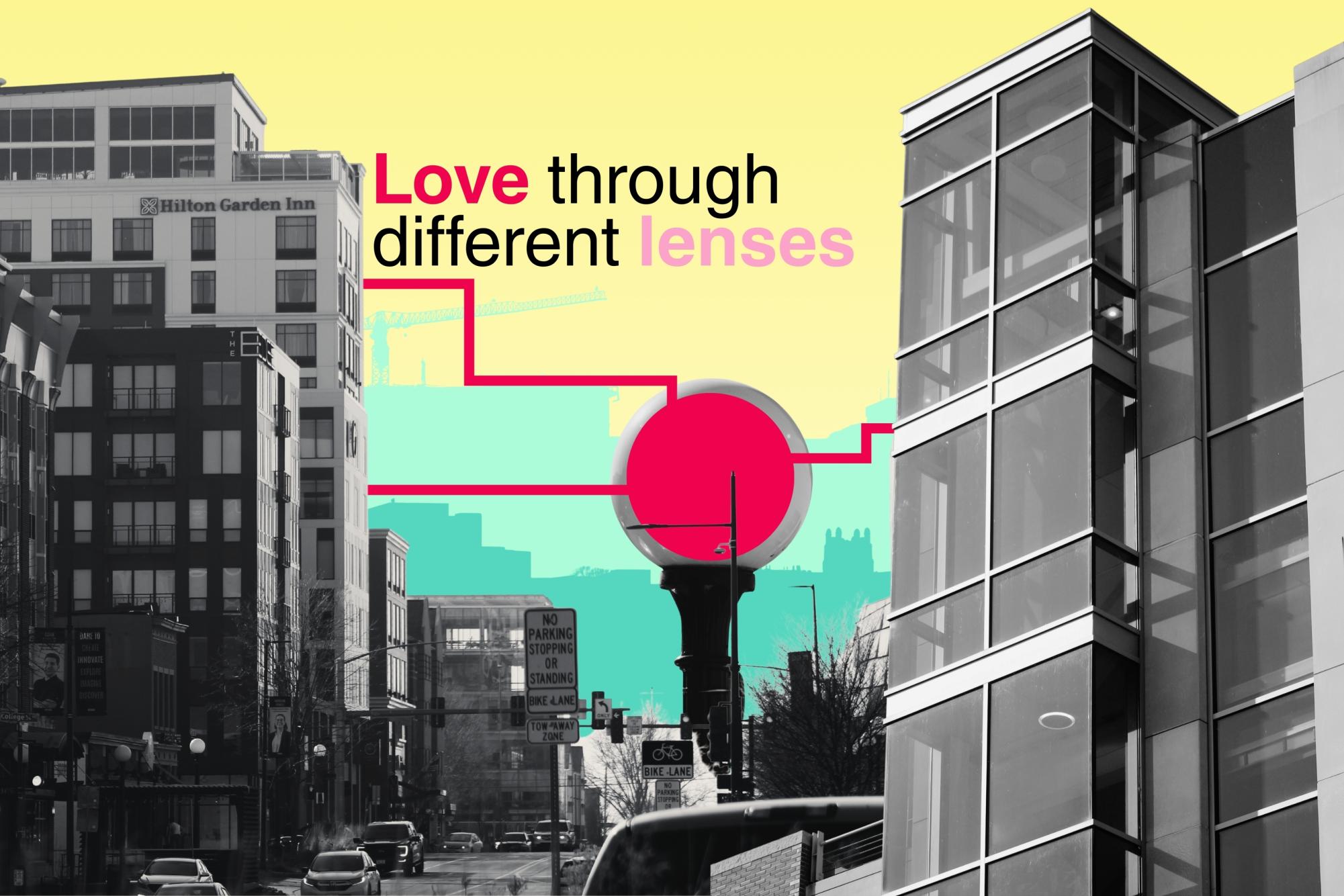
Love through different lenses

At West High, love doesn’t always adhere to the picturesque family structures of mid-century America.
Throughout the years, the United States' perception of love has grown beyond initial stereotypes.
Throughout the years, the United States’ perception of love has grown beyond initial stereotypes.
Jack Sun
Love beyond tradition

For much of the 20th century, American culture depicted love through a conventional lens. Sitcoms, advertisements, textbooks and political speeches, influenced by centuries-old ideas, have portrayed a household composed of a mother, a father and their biological children in a family unit. Many families, however, have always existed outside of that frame, and under legal and societal changes, the paradigm has begun to shift.

In 2015, the Supreme Court legalized same-sex marriage nationwide in Obergefell v. Hodges, granting millions of LGBTQ+ Americans formal recognition of their relationships. The ruling expanded access to adoption, parental rights, hospital visitation and legal protections, allowing families to exist with security rather than uncertainty.

Since this landmark decision, these changes have spilled beyond Capitol Hill into many American homes. At West High, they live in the experiences of students like Jack Jensen-Fitzpatrick ’26, who grew up with two mothers, University of Iowa Women’s Basketball Coach Jan Jensen and physical therapist Julie Fitzpatrick. Despite this nontraditional familial structure, he describes his family life as nothing out of the ordinary. 

“Even though we have two moms, it feels completely normal. From families I’ve been around, the dynamics [are] sort of the same. This is just how we [are],” Jensen-Fitzpatrick said.

Jensen and Fitzpatrick moved to Iowa City in 2000, an LGBTQ-friendly community that would welcome them as a family like no other. Through resources at the University of Iowa Health Care Medical Center, the couple built their family through in vitro fertilization and had two children, Jack and Janie.

“We made a conscious choice to come here as a couple, and we were received in a very positive way. I will forever be grateful for that experience,” Fitzpatrick said. “There were opportunities for same-sex couples to have kids through IVF. We have lots of male role models in our lives that are part of our support system and have influence on our kids, and we’ve tried to raise them just like any other parent does.”

Although the Jensen-Fitzpatricks have found a supportive community in Iowa City, the journey wasn’t always straightforward. While Fitzpatrick notes that she didn’t feel alienated due to her sexual orientation, she was still nervous to come out to her family growing up.

“I never really felt ostracized. I felt more like I didn’t want to disappoint. I still wanted to be viewed as a productive, successful and good person. I do feel like I’ve been received that way,” Fitzpatrick said. “Jan and I try really hard to live our lives. We realize there are different opinions out there. We want to accept other people for who they are, but we also are confident in who we are. We try to be a good example for others, and hopefully that has a ripple effect on how other people view our life.”

For Fitzpatrick, it’s the shared love between household members that makes them a family, not their composition.

“Our family just happens to have two moms. Some have two dads. Some have one mom. Some have one dad. My hope when the kids get older [is] that they look back and they’ll be like, ‘Man, I’m really grateful that I had parents like that,’” Fitzpatrick said. “We might be different from most people, but it’s just life.”

Above all, Fitzpatrick notes how the biggest joy in her life has been her kids. 

“We’re blessed with two great kids that see the world in a really positive way, but I don’t think they see their situation as any different,” Fitzpatrick said. “It’s just a family. I hope that gives them a good start as they start their adulthood.”

Like on the basketball court, the Jensen-Fitzpatrick family prioritizes remaining a team, pushing each other through challenges and celebrating successes.

“Every day, we really embrace one another. We consider ourselves a team and help each other through the hard times and the good times,” Fitzpatrick said. “We’ve had some really great moments; we’ve gotten to experience Jan and her world, which is a really fun, exciting life. We have a supportive family. We treasure family, we treasure positive times together and we support one another.”

According to the Williams Institute of Law, around 300,000 children in the United States are being raised by same-sex couples. Through his upbringing, Jensen-Fitzpatrick has been able to see the world through a new lens and embrace others with openness, regardless of whom they love.

“I’ve definitely learned to accept people for who they are. They love each other, and I see no problem with it. I feel like people care too much about individual relationships [when] two women love each other [or] two men love each other,” Jensen-Fitzpatrick said.

Beyond family dynamics, Jensen believes it is not the amount of conflict, but the way in which family members bounce back from conflict that shows true love.

“At the end of the day, you could have your issues, but there’s never a question of how much you love each other. There could be frustration at the moment, but it’s also an understanding at that moment. Some days are better than others,” Jensen said. “Love for each other is about the authenticity of being vulnerable with each other and celebrating the ups and the downs.”

For the Iowa women’s basketball team, teamwork and unity are everything. Jensen notes how she brings that mindset off the court, not as a coach but as a wife and mother.

“We know that when the chips are down and when things are up, we will always have one another,” Jensen said. “This is Team Jensen-Fitzpatrick, and that, to me, is everything.”

Love beyond bloodlines

Eric Clark ’27 does not begin describing love in his family by listing the names of those who share his house or tracing a family tree; instead, he begins with a principle that anchors them all.

“It’s a choice. Familial love is not something that you owe anybody. It’s not something that you can teach. It’s something that is earned, and it’s not something that’s related through blood at all,” Clark said.

Clark was adopted at the age of eight after spending time in the foster care system with his biological younger brother, Tiberius. His adoption required countless months of fostering, interviews, training and home evaluations for his two fathers, Paul and Chad. For Clark, family is not something that he was born into, but something he had to learn to trust.

“To me, loyalty to those you trust is the most important, more than being [biologically] related,” Clark said. “This is my family. I chose to be here. I chose to be adopted. I chose these people, and they chose me. It’s a different kind of belonging.”

Trust in Clark’s family developed slowly. In the early stages, his parents worked to create an environment built on privacy and stability by offering him small choices, restoring his sense of control after early childhood trauma. He could lock doors, refuse foods he disliked and ask for space when necessary. Each minute decision contributed to a larger sense of safety.

“I have to learn to trust in a different way. It’s not innate. It’s not, ‘This is my family because I was born here.’ It’s, ‘This is my family because they fought for me here,’” Clark said.

Clark’s family uses a number system he calls “one, two or three” to communicate the seriousness of issues within the household. This system prevents raised voices and misunderstandings by encouraging clarity and honesty.

“If you can’t have honesty, you can’t have loyalty. If you can’t have loyalty, you can’t have family,” Clark said. “Especially because I had to learn to love these people; I had to learn to trust these people. It’s very important to be specific and honest and to not leave people wondering how you’re feeling.”

While Clark was initially uncertain about whether he wanted to be adopted by his dads, time and patience facilitated a strong emotional connection with his parents, understanding that they would be there for him through highs and lows. Alongside that relationship, Clark maintains a tight bond with his biological brother, whom he took on a parental role for as a child.

“Early in my life, I had to take care of him to the point where I was like a parental figure, which is not something you ever want a kid to do,” Clark said. “I grew up [with the] responsibility that I’m in charge of my brother, and I need to make sure he’s safe. That worked while we were in early foster care and before we were fostered, but as we got older, I had to learn to let go of trying to be his parent. It was hard for me to transition back into being his sibling.”

According to the Adoption Network, only 2-4% of families in the United States have adopted children. Clark believes that conversations about adoption and family require curiosity rather than judgment. 

“Hate is taught, disrespect is taught. If you’re unopened to learning, then you’re unopened to life. I’ve never been persecuted or attacked verbally by anybody who matters. It’s always somebody who doesn’t understand, who’s angry or has their own issues. I don’t entertain those sorts of people. I know who I am. I know who my family is,” Clark said. “You [have] to come from a place of love. If you’re asking questions [out of] curiosity, you can never get yelled at.”

In the end, Clark emphasizes that what truly makes a family is the willingness to fight for each other through all the ups and downs of life. He adds that patience and understanding are the strings tying family members together, blood-related or not.

“I’ve done things I’m not proud of. Even though my parents are fabulous parents, everybody makes mistakes, and it’s just [having] patience in them trying to fix those mistakes, and trusting them,” Clark said. “Nothing happens overnight, and every day is a choice.”


Love beyond romance
Love beyond romance

As reflected by the Jensen-Fitzpatrick and Clark families, love can come in multiple forms. However, not everyone in the world experiences frequent romantic attraction — or any. Freshman Maple Orth identifies on the aromantic and asexual spectrums, meaning they feel little to no romantic or sexual attraction. According to Orth, discovering they were aromantic was both relieving and alienating.

“I grew up in the South for a while. It was a lot of ‘Girls marry boys, and that’s all there is; women need to be in a relationship with a man, and men need to be in a relationship with women,’” Orth said. “Since discovering that I don’t like guys and that I’m aromantic and asexual, it’s been a lot of understanding that that isn’t the future. That doesn’t have to be all there is in relationships.”

Growing up, Orth often felt ostracized due to not experiencing romance in the same way as those around them.

“When I was younger, I felt that obligation to have a crush on a boy. Other girls were like, ‘Oh my gosh, I love this boy, I’m dating this boy,’ and I was saying, ‘I don’t really [feel] that,’ so I was copying [and] masking who I was,” Orth said. “I did feel isolated because I grew up in a more conservative group. I felt really, really isolated and alone in that because I was different.”

Although previously feeling no romantic attraction, Orth opened up to a new perspective upon meeting their current girlfriend. 

“It was shocking. Like, ‘Oh my gosh, I could talk about this person for hours, and she’s amazing.’ I just go on rambles, and my friends are like, ‘You don’t talk about somebody like that. You’re acting like you like somebody,’” Orth said. “It was really interesting for me realizing this is what loving someone feels like.”

However, even though Orth has experienced romantic feelings, they still identify on the aromantic spectrum, stressing that people can experience attraction and still be aromantic. According to Orth, this is just one of the misconceptions they have faced surrounding their romantic orientation.

“People say, ‘Aromantic people can’t like anybody,’ or ‘You’ve just not found the right person yet,’” Orth said. “Another misconception for asexual people is that you don’t find anybody physically attractive. No, it’s just I don’t want that. It’s called a spectrum for a reason. I just feel less romantic attraction.”

According to the University of California Resource Center for Sexual and Gender Diversity, only 1% of the U.S. population identifies on the aromatic spectrum. Despite the small percentage, Orth encourages people who identify as aromantic to create community by reaching out and supporting one another.

“You’re never alone. You don’t have to have a label for yourself, but for me, labels help me feel less alone,” Orth said. “If you feel like you want to identify [as] aromantic, know maybe you are not exactly the same, but you’re not alone.

Orth believes that love can be found in a variety of relationships not limited to romantic attraction. They add that it is important not to overly depend on one individual and instead to foster a well-rounded network of supporters, including family and friends.

“A lot of people rely on their [partner], but not everybody needs that. Nobody has to have a partner. Never feel obligated to date somebody. Never feel forced to have romantic attraction. If you feel romantic attraction, amazing — you can still identify as aromantic,” Orth said. “I [have] a lot of strong friendships and familial relationships, and I realized that relying on just one person, that being your romantic partner, makes it [difficult]. You need a real support network. It’s important to build strong platonic connections.”

For Orth, unconditional love means supporting someone no matter their sexual orientation, romantic orientation or gender identity.“Having friends, a partner or family that will support you for who you are — their love doesn’t come with conditions. Even if they don’t fully understand, they’re willing to listen to you,” Orth said. “It’s important to keep those healthy relationships and make people understand, ‘Just because I’m coming out to you as aromantic doesn’t mean I’m a different person. I’m still the same person, you just know something new about me.’”

Donate to West Side Story
$1600
$2000
Contributed
Our Goal

Your donation will support the student journalists of West High School. Your contribution will allow us to purchase Scholarship Yearbooks, newsroom equipment and cover our annual website hosting costs.

Navigate Left
Navigate Right
Donate to West Side Story
$1600
$2000
Contributed
Our Goal