

































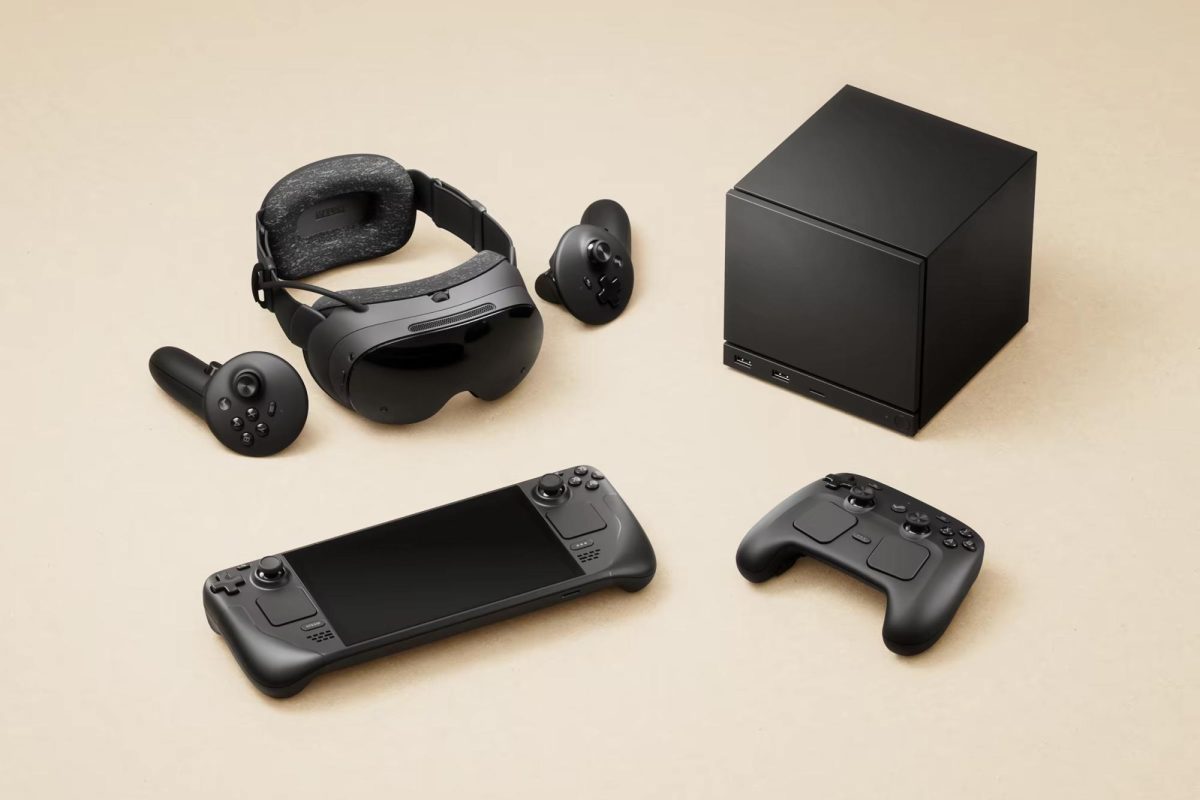
Valve Corporation, known for their critically acclaimed games and their digital game storefront, Steam, announced three new pieces of hardware to go along with their Steam ecosystem: the Steam Controller, the Steam Machine and the Steam Frame. Various media outlets and social media influencers were flown out to Valve’s headquarters in Bellevue, Washington, to experience these new devices and talk to the engineers who made them. Valve intends to use these hardware launches to bring more ways to play games on Steam to players, like they did with the Steam Deck being a mobile device for playing games.
The Steam Controller is an unusual controller, with PlayStation-style joysticks and Xbox-layout face buttons along with two trackpads and capacitive touch sensors. Many have criticized the layout, calling it an “abomination” that “looks uncomfortable.”

This unusual layout comes from Valve’s previously released Steam Deck handheld gaming device, which also had similar heavy criticism for looking like it would be uncomfortable, but when users got their hands on it, they praised the controls for its ergonomics and functionality, with a common highlight being the trackpads allowing for mouse cursor usage with the controller.

Reviewers at the press event similarly praised the controller’s ergonomic design, with IGN saying that “it felt natural to hold with contours and substantial grip where you expect them, and it remains fairly light so it doesn’t feel like you’re holding on to a hulking game pad.”
The joysticks and the gyroscope have been highlights for reviewers, with the joysticks using tunneling magnetoresistance sensors for low stick drift and power consumption, along with the gyro for fast, precise aiming and mouse control.
Another highlight for reviewers at the press event was the charging puck-wireless receiver combo, with the charger magnetically snapping to the controller to charge and acting as a wireless receiver for the controller. Valve claims that the wireless receiver has an extremely low and constant latency compared to Bluetooth’s large and variable latency, even when four controllers are paired to the same puck simultaneously.
The Steam Machine is Valve’s entrance into the console space, with a semi-custom CPU and GPU from AMD that Valve claims will have six times the performance of the Steam Deck. DigitalFoundry has claimed that this will put it at a performance between the Xbox Series S and the Playstation 5.

Many reviewers and people on social media expressed disappointment with the specs, especially with the small amount of VRAM on the GPU at eight gigabytes, but in an interview on the YouTube channel Adam Savage’s Tested, a Valve engineer claimed that it has similar or better performance than what 70% of gamers have in their PCs, with social media users noticing that the specs are nearly identical to the most popular hardware according to the Steam Hardware Survey.

The Steam Machine, as with the Steam Deck, runs Valve’s Linux-based SteamOS operating system, giving it various console-like software features such as quick suspend/resume and downloading of game updates while on standby, along with slightly improved performance over Windows due to reduced overhead.
The majority of the Steam Machine’s very cubical volume is taken up by a heat sink, which reviewers have noted keeps the processor cool with very little fan noise. The six-inch-wide cube form factor has also led to comparisons to Nintendo’s 2001 GameCube console, with many on social media nicknaming it the “GabeCube” after Valve’s CEO, Gabe Newell.

The Steam Machine, like the Steam Deck, is unique within game consoles in that it’s not a locked-down system only made to play games, as both devices are capable of running any software or operating system that the user wants to use, much like a PC. “Yes, Steam Machine is optimized for gaming, but it’s still your PC. Install your own apps, or even another operating system. Who are we to tell you how to use your computer,” Valve said on the marketing page for the Steam Machine.
Linus Sebastian of Linus Tech Tips criticized the naming of the Steam Controller and Steam Machine on the WAN Show podcast, as they have identical names to Valve’s previous attempts at a controller and console in 2015, calling it “nothing but confusing. Calling something the exact same thing is completely unnecessary.”

The Steam Frame is Valve’s new virtual reality headset, superseding the 2019 Valve Index. While the Index was a tethered outside-in headset with a cable connecting to a computer and external sensors for tracking, the Steam Frame is more similar to a Meta Quest in that it’s a standalone inside-out headset with its own processing and built-in cameras for tracking.

A high point for reviewers at the press event was the exceptional lightness and comfort, with the Steam Frame weighing in at just 440 grams, compared to the Meta Quest 3’s 515 grams or the Apple Vision Pro’s 750 grams, on top of the Steam Frame’s weight being distributed more evenly due to the rearwards battery pack compared to other headsets having all the weight in the front.
Unlike many other standalone headsets where tethered/streamed VR games from a PC is a neglected aspect, the Steam Frame offers high fidelity support for wireless streaming of PC VR games, using a dedicated USB stick for wireless connectivity to the host PC. The Steam Frame does not have the visual fidelity loss of most wireless VR streaming setups through the dedicated connection, and provides high bandwidth and low latency, along with the eye tracking in the Steam Frame allowing the USB stick to only transmit the user’s central vision at high fidelity and lowering visual fidelity in the peripheral vision. Reviewers at the press event remarked at how well this “foveated streaming” worked, with Sebastian remarking that “it reacted so fast, no matter how quickly I moved my eyes, I wasn’t able to catch it.”

The Steam Machine and the Steam Frame, just like with the Steam Deck, have access to the exceptionally large library of games available to buy on the Steam storefront. This is a rather large selling point, as the Steam Machine and Steam Frame will not need to worry about its launch library of games. The Steam Frame also has the benefit of being able to play non-VR games via a virtual display in its VR environment, giving it access to the large PC game library on Steam on top of its VR game library.
Valve has not announced pricing at this time, however they have stated that the Steam Controller will be priced like a standard controller, the Steam Frame will be priced lower than the Index, and most controversially, the Steam Machine will be priced less like a console and more like a PC. Speculation on social media has run wild on the pricing for the Steam Machine and the Steam Frame, with some lamenting that the Steam Machine’s price will not be subsidized by game purchase like a Playstation or an Xbox, while others justifying it that given its nature as a PC, some many buy it and never interact with the Steam store, making Valve lose money from the subsidization. As the cost of PC parts have gotten more volatile in recent months, some consider it a smart move to not commit to a price until closer to the release date, with GPU prices getting more and more expensive since the rise of cryptocurrency and RAM prices doubling or even quadrupling in recent months due to AI datacenters buying up the supply of memory chips.