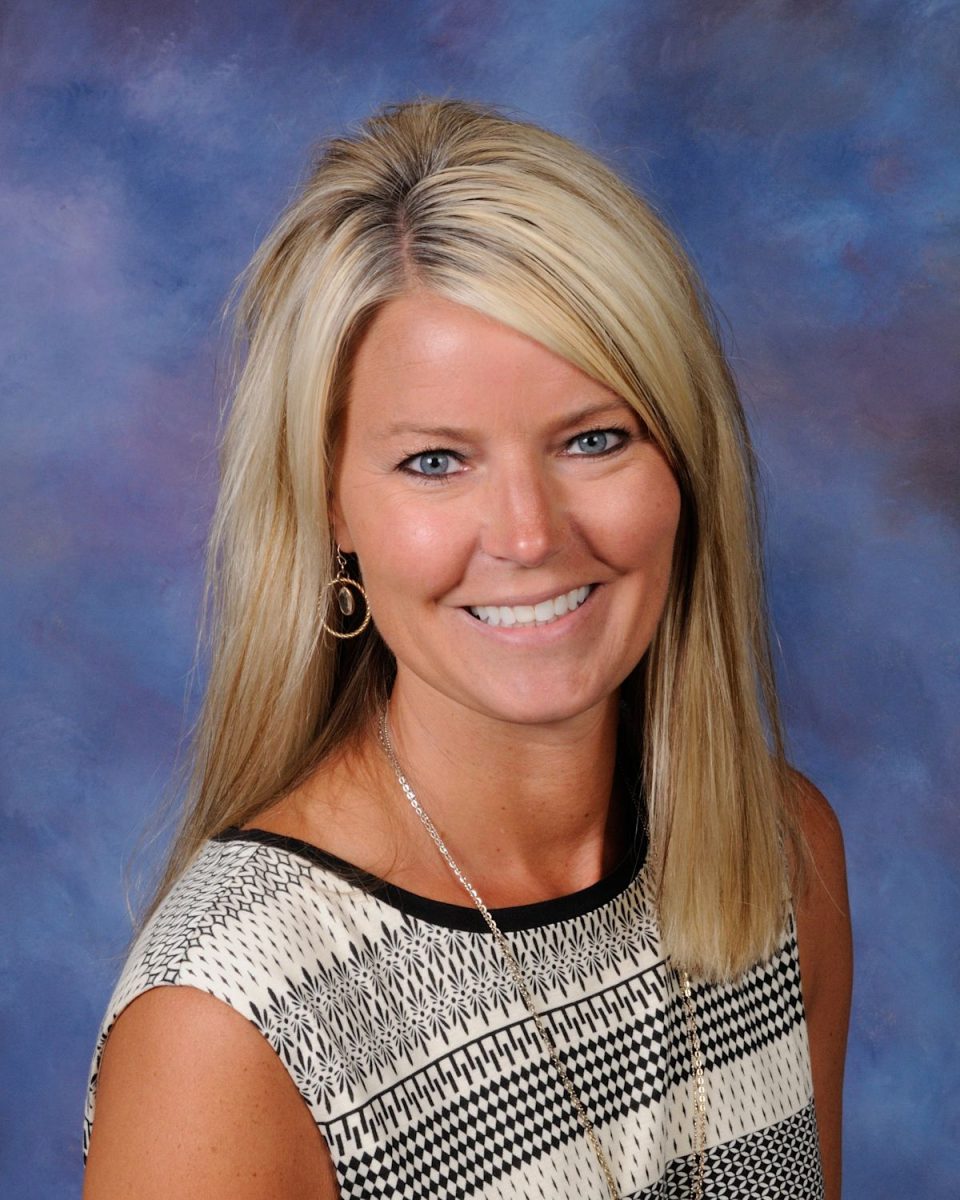

































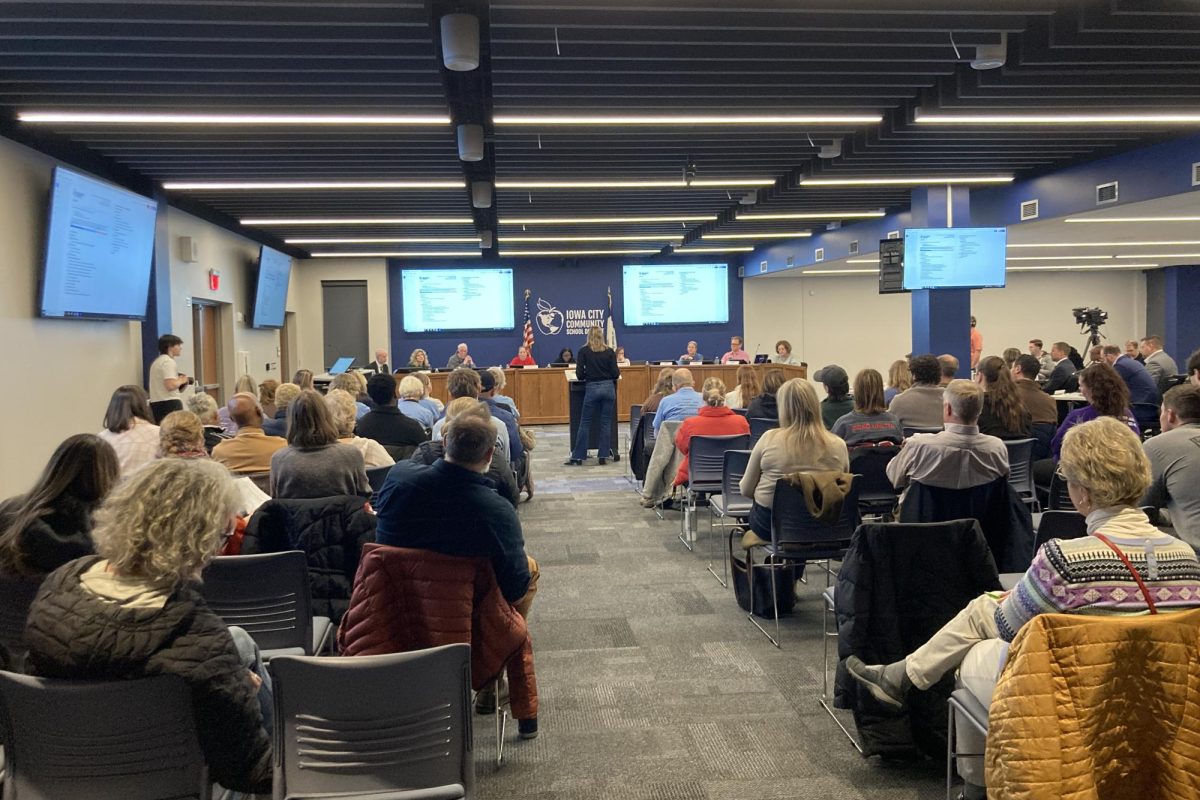
Iowa City Community School District Superintendent Matt Degner presented potential budget cuts at a packed school board meeting Feb. 24.
In August, ICCSD administration took out a $10 million interfund loan, moving money from the district’s health insurance fund to the general fund. At the time, the district’s financial staff didn’t seek approval from the school board, believing that the action didn’t require board authorization.
But, Iowa law requires the approval from a governing board for an interfund transfer, making the August transfer unlawful. Additionally, the board has a policy that would, at the very least, require notice for any interfund loans made. Based on the legal team’s recommendation, the board retroactively approved the loan Jan. 27 after questioning from directors Mitch Lingo and Jayne Finch.
“I’m still wondering why this wasn’t communicated to the board in that September quarterly financial report,” Finch said during the meeting. “The board needs to have an understanding of our financial situation, and the fact that we had to take the loan does suggest to me that perhaps our cash position, our unspent authorized budget or balance, is not as robust as we thought it was.”
According to Superintendent Matt Degner, ICCSD administration believed that the issues were simply the timing of funds, because they only receive funding from the state in two large installments throughout the year. Five months after the loan was taken out, it became clear that the district was still in financial trouble, raising concerns throughout the community.
Chief Operating Officer Curt Pratt spoke about the uncertainty surrounding the transaction when asked why this temporary moving of funds was needed for the first time since 2017.
“We get our two largest payments in October and in April, when we get our property tax receipts. As we start the fiscal year, September is traditionally one of our largest payrolls, as we bring on new employees and get the school year started,” Pratt said.
At the board’s next regular meeting Feb. 10, five community members spoke during community comment, raising concerns about the financial state of the district.
Community members raise concerns
Emily Campbell, an ICCSD graduate and parent, is an Associate Vice President for Operations and Decision Support at the University of Iowa with two decades of experience in accounting. She presented board members with a packet detailing shortcomings of the district’s financial reporting and raised many questions and concerns during the four minutes she had to speak. She also spoke at the meeting Feb. 24.
According to Campbell, the district failed to provide the board with an audit report, which would have described the material weaknesses and deficiencies of their budget. These issues with the district’s financial control were noted in the fiscal year 23 audit. However, many corrections were never made, leading to other problems, including missing bank reconciliations and reusing last year’s financial data at times.
Campbell also noted that four funds totaling $17 million were removed from financial reports. If these funds were present in the reports, the $10 million loan from the health insurance fund would have been visible, but the district chose to stop reporting data for the fund from which the loan was withdrawn during this time.
“Taken together, this pattern over the past five months should not raise concerns about employee turnover or errors from the financial team. It should raise serious concerns about the integrity of top district leadership,” Campbell said.
Maka Pilcher Hayek, who previously served on the board for two years and retired in November 2023, also spoke out about her anger around the handling of funds and encouraged the district to employ an outside accounting firm.
“As a taxpayer, I hope you’ll retain an outside accounting firm on an emergency basis to explain how the administrative team put us in the position again and what we can do to get ourselves out of it without damaging student learning. At this point, it would be irresponsible for this board to trust the current administration with this kind of assessment,” Pilcher Hayek said.
Her husband and former Iowa City Mayor Matt Hayek spoke out about the board’s responsibility to ensure that they had competent financial leadership.
“The board should have accounting professionals working directly with all seven of you. Your risk will only grow,” Hayek said. “Until the financials are accurate, you cannot plan for the future, and each week that passes is lost time. Let me close with this. The community members speaking here tonight love this district and they’re here to protect it, and I hope you’ll protect it too.”
Degner takes responsibility, Board raises questions
Degner spoke after community comment Feb. 10 and took responsibility for how the interfund loan was handled.
“As we’ve unpacked our budget, it’s evident that it simply was not a timing issue and that we have a structural issue on the cash flow side as well as a concern on the authority side of our budget,” Degner said.
Degner said that it had become clear that the district would need to take out loans, along with reducing costs. To meet this goal, the district has been working with the Department of Education, the School Budget Review Committee, the Iowa School of Finance Information Services, school business officials from across the state and the district’s legal counsel. Pratt, along with Director of Financial Reporting Alan Moran, has been working to uncover the extent of the underreported costs and make a plan for the future.
Degner also said that the district would be looking into utilizing outside help after community commenters urged them to use an outside accounting firm. Additionally, the role of chief financial officer will be filled by an interim officer while the job remains vacant.
During the discussion, Director Charlie Eastham pointed to the low supplemental state aid increases as being partially responsible for the district’s troubles.
“I haven’t seen any data at all that suggests that our financial situation is perilous,” Eastham said. “It is certainly problematic, and it is primarily as a result of the legislature’s decision-making process.”
Iowa’s State Supplemental Aid is the amount of money that districts are given per student that they serve. This funding, along with property taxes, serves as the main funding source for Iowa public schools. In the early 2000s, public school SSA increased by around 4% each year. But since 2013, the rate of increase has hovered around 2%, including this year, due to a bill Gov. Reynolds signed this week increasing SSA by 2% for the upcoming fiscal year.
Some argue that this is not enough. At present, inflation is declining, but it is 2.4% currently and has been above 2% since 2020. In effect, the amount of purchasing power that the district receives per student has decreased, compounded for the ICCSD by enrollment decreases in recent years.
Finch agreed that state funding hasn’t been high enough; however, she maintained that the current cuts could have been avoided with proper planning and budgeting.
“The state funding is a problem, but we have to govern in reality. We know how much money we have. We have to make a budget. The projections need to be accurate, and we need to stick to it,” Finch said.
Financial team proposes solutions

The board agenda for Feb. 24 largely focused on possible solutions to get the district back on track. For short-term funding, the board discussed a tax anticipation warrant with MidwestOne Bank for $3 million. This loan would cover the March payroll with an interest rate of 6.25% on any spent funds, to be repaid by June 30 at the latest.
With these temporary funds, the board will also be hiring an interim Chief Financial Officer to hold the position until a permanent employee can be found. The previous CFO, Adam Kurth, left near the end of 2025 after the loan was made without informing the board. Since then, Pratt managed the finances of the district while the job posting remained open.
ICCSD staff has already received a list of proposed cost-saving measures for the remainder of the school year. A few are as follows:
- Each building’s budget has been reduced by 20%
- Credit card limits reduced by 50%
- Transportation is limited to yellow school buses or district-owned vans for athletics and activities
- Hiring freeze for the remainder of the school year and limits on education and experience for any 2026-27 school year hires
- A pause on non-essential construction
The district’s interim CFO, Kim Michael-Lee, officially started Feb. 25 with some changes to her position. Her official duties will include more explicit oversight of the district’s financial team and reporting directly to the board of directors, including at a special meeting March 3. The board hopes to hire a permanent CFO by July 2026.
While Michael-Lee will be responsible for determining the exact amount of cuts that the district requires, current estimates place the number around $6 million. At the meeting, Degner presented the initial proposed cuts, including:
While the budget cuts involve staff downsizing, the board made clear that most non-administration positions would shrink through attrition: not hiring replacements for retiring staff, voluntary resignations and possible non-renewals based on performance.
Still, this plan received criticism from community members. Angie Rogers, a Coralville parent, spoke up about the volume of student-facing cuts, as compared to central administration cuts.
She specifically addressed the $5 million that she said would directly affect classrooms, instruction and student support. Administration reduction was only around $2 million, and she said those cuts seem less specific and are largely focused on reassignment or attrition.
“That is not the same level of sacrifice. Students and teachers will feel these cuts immediately; central administration will not. If this district is facing true financial problems, then we must be willing to consider structural changes at every level of the district,” Rogers said.
She also said that the central administration seems to be protected from the brunt of the cuts, while classrooms will be the most affected.
“Budgets reveal what an institution chooses to protect and what it chooses not to,” Rogers said. “If classrooms absorb the majority of reductions while central administration remains insulated, that sends a clear message and is not one that builds confidence in district leadership or this board.”
Pratt presented on the future of the district’s finances, including planned dates for budget hearings. The district will establish its maximum property tax rate by March 5. The first public hearing for the 2027 fiscal year budget will be at the regular board meeting March 24, with the proposed budget finalized April 14.
Looking to the future, Finch concluded that the board needed to be more careful with funding, especially given their lack of a permanent CFO.
“My frustration is that we just seem to be flatfooted when it comes to decisions like this, and we wait until a crisis moment to make these types of decisions. It’s my hope that we learn from it and we are more proactive in the future,” Finch said.
Full videos of the Feb. 10 and Feb. 24 meetings can be found on the Board’s YouTube channel.
Editor’s note: An earlier version of this article mistakenly attributed a quote to Lisa Williams instead of Jayne Finch. We apologize for the error.